
Money
How to Tell If a Sale Price Is Actually a Good Deal
How do I know if a discount is real or just marketing?
A sale price is only useful if it is lower than the real market price, not just lower than a number a store decided to cross out.
Why This Matters
Modern shopping is designed to make urgency feel rational.
You see a countdown timer. A red discount badge. A crossed-out price. A message that says “limited time,” “only a few left” or “23 people are viewing this now.” By the time you reach checkout, the site may add shipping, service fees, delivery charges, subscriptions or warranty prompts.
Sometimes the deal is real. Sometimes the product is genuinely cheaper than usual.
But sometimes the sale is theater: a high reference price, a markdown that repeats every weekend, a bundle that hides the real cost or a discount that disappears once fees are added.
The problem is not that sales exist. Sales can be useful. The problem is that a discount does not automatically mean value.
The smartest shopper does not ask, “How much is it marked down?” The better question is: compared with what?
The Short Answer
A sale price is a good deal only if the final price is meaningfully lower than what the same or comparable product usually costs, from a trustworthy seller, with the features, warranty and return policy you actually need.
The fastest check is this:
- Look up recent price history.
- Compare the same model at other reputable stores.
- Check the final checkout total after shipping, taxes and fees.
- Ask whether you would still buy it without the sale badge.
If the deal passes those tests, it may be real. If it only looks good because of a crossed-out price, countdown timer or vague “up to” language, slow down.
A discount is not proof that you are saving money. It is an invitation to check the math.
The Crossed-Out Price Is Not the Deal
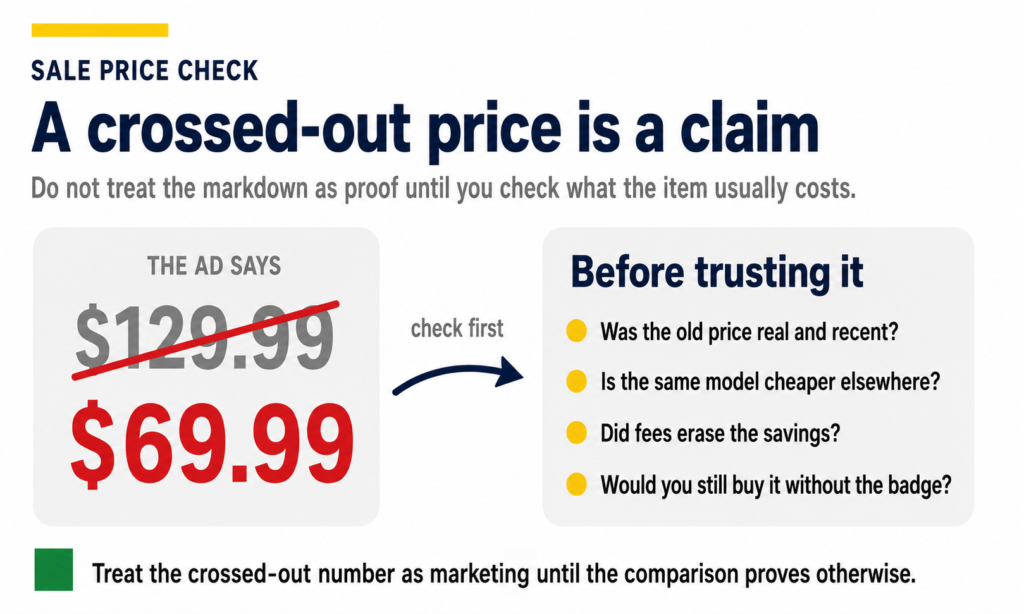
The most common trick is the crossed-out price.
A product appears at $69.99, crossed out from $129.99. That makes the discount look huge. But the important question is whether the product actually sold for $129.99 recently and regularly.
The FTC’s Guides Against Deceptive Pricing address this basic idea. A former price comparison can be legitimate when the former price was a real price at which the product was openly offered for a reasonably substantial period. But if the former price is artificial or inflated to create the appearance of a bargain, the advertised deal can be misleading.
In plain English: a store should not invent a fake “was” price just to make today’s price feel better.
For shoppers, the takeaway is simple. Treat the crossed-out price as a claim, not proof.
Check the Price History
The strongest test is price history.
If a product is “on sale” for $89, but it has been $89 for three months, that is not much of a sale. If it was $129 last week and $89 today, that is more meaningful.
Use a price tracker when possible. Tools such as CamelCamelCamel or Keepa can help with Amazon price history. Google Shopping and some browser extensions can also show price changes or compare sellers. These tools are not perfect, but they are useful because they shift the question from “what does the banner say?” to “what has this product actually cost?”
Look for patterns:
- Does this item go “on sale” every weekend?
- Was the price raised shortly before the discount?
- Is today’s price actually low compared with the last 30 to 90 days?
- Is a newer model making the old model cheaper?
- Is the discount only for an unpopular color, size or configuration?
The best deal is not always the lowest price ever. But you should know whether you are seeing a rare discount or routine marketing.
Compare the Same Model, Not Just the Same Product Name
Retailers know that product names can be confusing.
A laptop, TV, vacuum, blender, smartwatch or air purifier may look almost identical across stores while having different model numbers, storage sizes, accessories, chip versions, bundles or warranties.
That makes price comparison harder.
Before deciding a sale is good, compare the exact model when possible.
Check:
- model number;
- year or generation;
- storage or capacity;
- included accessories;
- warranty length;
- return window;
- seller reputation;
- refurbished, open-box or new condition.
A cheaper price may not be better if the product is older, missing accessories, sold by a questionable third-party seller or harder to return.
Watch the Final Checkout Price
The sale price is not the final price.
Shipping, handling, service fees, delivery charges, installation, subscriptions, accessories and extended warranties can change the math. A product with a lower sticker price can end up costing more by checkout.
This matters most for:
- event tickets;
- hotels and short-term rentals;
- furniture;
- appliances;
- travel bookings;
- electronics;
- subscription products;
- large items with delivery fees.
The FTC’s final Junk Fees Rule targets bait-and-switch pricing for live-event tickets and short-term lodging by requiring clearer total-price disclosure. But the broader shopping lesson applies everywhere: compare the full amount you will pay, not just the first number you see.
If a deal needs fine print to survive, it may not be much of a deal.
Beware of “Up To” Discounts
“Up to 70% off” does not mean the item you want is 70% off.
It usually means at least one item in the promotion has a discount that large. The product you actually want may be 10% off, excluded from the sale, available only in limited sizes or tied to a bundle.
This phrase is not automatically dishonest. But it is designed to pull you into the sale before you know whether your item qualifies.
The practical move: ignore the biggest percentage on the banner and check the actual item price.
The Timer Is Not Always Your Friend
Countdown timers can be useful for real limited-time events. They can also pressure you into acting before comparing prices.
The FTC has warned about dark patterns: design tactics that can trick or manipulate people online. Common examples include fake urgency, hidden costs, confusing cancellation paths, preselected add-ons and design choices that make one option easier to pick than another.
If a site says a sale ends in 12 minutes, ask:
- Does the same sale return tomorrow?
- Is the timer real?
- Can I find the same price elsewhere?
- Am I buying because I need it or because the timer changed my mood?
Urgency is powerful because it interrupts judgment. A real deal should still make sense after you take five minutes to check.
Separate Need From Discount
The cheapest unnecessary purchase is still unnecessary.
A sale can make a product feel like an opportunity instead of a choice. That is how people end up buying gadgets, clothes, kitchen tools, software trials or subscriptions they never use.
Before buying, ask one simple question:
Would I still want this if it were not on sale?
If the answer is no, the discount is doing most of the work. That does not automatically mean you should walk away, but it does mean you should pause.
Another useful question:
Where will this fit into my actual life?
A discounted air fryer, smartwatch, suitcase, course, subscription or car accessory is only a good deal if it solves a real problem.
Use the 24-Hour Rule for Non-Urgent Purchases
For anything non-essential, waiting is a powerful tool.
If the item costs more than your normal impulse-buy range, leave it in the cart for 24 hours. A real need usually survives the wait. Fake urgency often fades.
During that pause, check:
- price history;
- other stores;
- reviews from long-term users;
- return policy;
- warranty;
- whether a newer version is coming soon;
- whether you already own something similar.
The goal is not to overthink every purchase. The goal is to give your judgment time to catch up with the marketing.
Check Reviews the Right Way
Reviews can help, but not all reviews are equal.
Look beyond the star rating. Read negative reviews, especially recent ones. Search for repeated complaints: battery problems, sizing issues, weak customer service, poor packaging, missing parts, software bugs or warranty frustration.
Pay attention to:
- verified buyers;
- long-term reviews;
- photos from real customers;
- repeated problems across multiple sites;
- whether complaints match your intended use;
- whether recent reviews are worse than older ones.
If every positive review sounds generic and every negative review mentions the same defect, the sale price may be trying to move a product with a known problem.
Compare New, Used, Refurbished and Open-Box
Sometimes the best deal is not the sale price on a new item.
For electronics, tools, appliances and gear, certified refurbished or open-box products can offer better value if the warranty and return policy are strong. Used items can also be smart buys when condition is easy to verify.
But the risk varies by category.
Used books, tools or furniture may be low-risk. Used electronics, car seats, mattresses, safety equipment and battery-powered products require more caution.
The question is not “new or used?” The question is: what risk am I taking, and am I being paid enough in savings to take it?
The Simple Deal Test
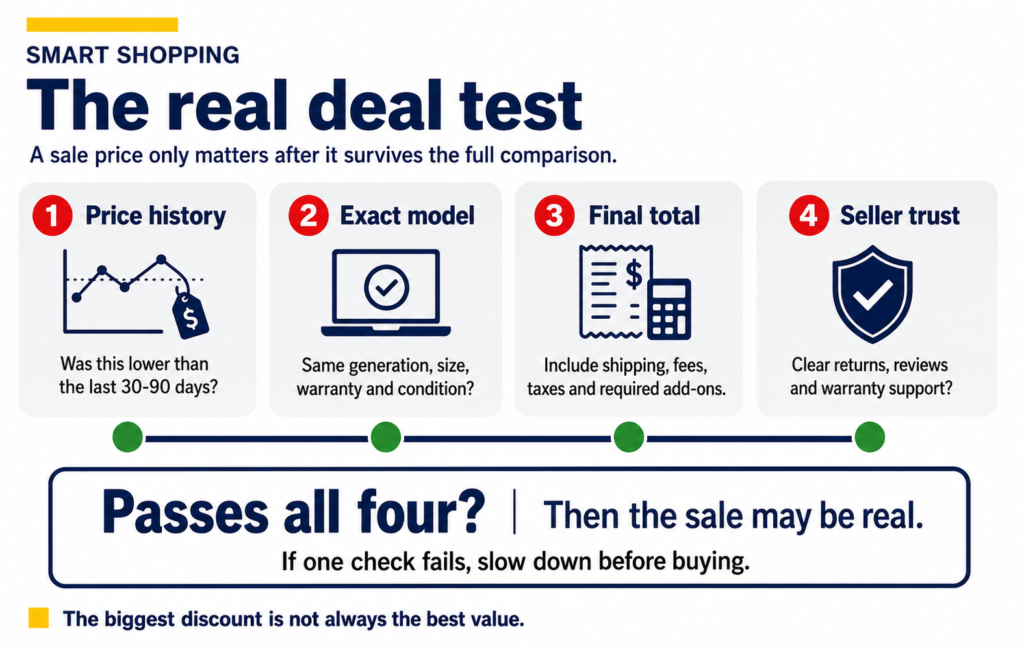
Before buying, run the sale through this checklist.
1. Is the discount based on a real previous price?
Check price history or other stores.
2. Is this the exact model I want?
Confirm model number, size, generation and warranty.
3. Is the final checkout price still good?
Include shipping, fees, taxes and required add-ons.
4. Is the seller trustworthy?
Check seller ratings, return policy and warranty support.
5. Would I buy it without the sale badge?
If not, wait.
6. Can I return it easily?
A deal with a bad return policy is less attractive.
7. Is there a better time to buy?
Some products follow seasonal price cycles.
When a Sale Price Probably Is a Good Deal
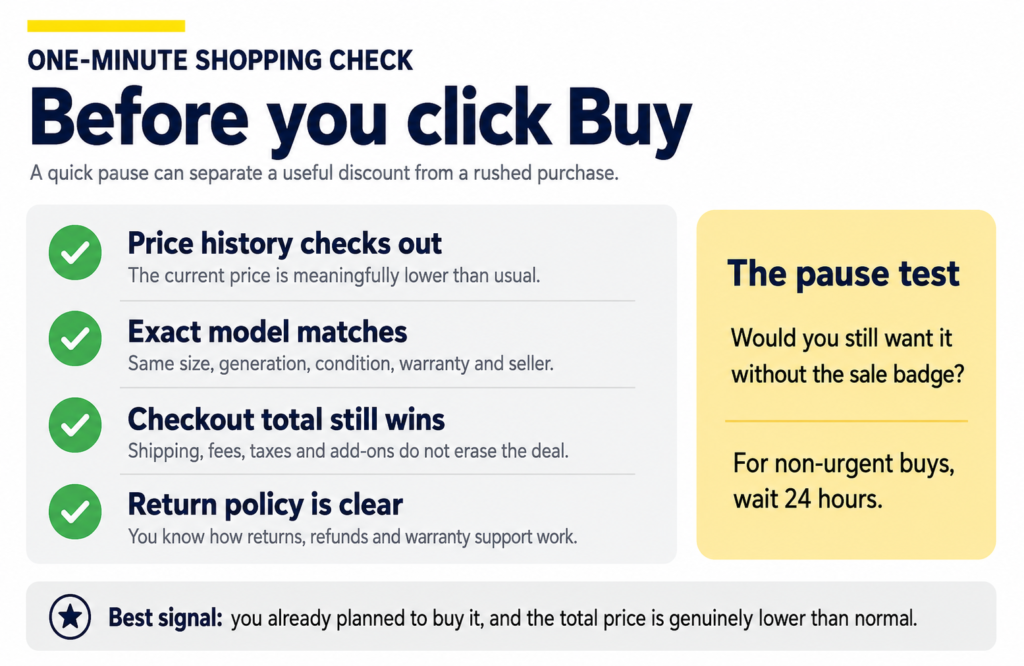
A sale is more likely to be real when:
- the current price is low compared with recent history;
- multiple reputable retailers show similar discounts;
- the product is not being replaced by a much better model immediately;
- reviews are strong and recent;
- the return policy is clear;
- the warranty is still valid;
- total checkout cost remains competitive;
- you already planned to buy the item.
That last point matters. The best discounts are on things you were going to buy anyway.
When to Walk Away
Walk away if:
- the sale depends on a fake-looking original price;
- the timer is pressuring you;
- the return policy is unclear;
- the seller is unfamiliar and poorly reviewed;
- the product has many recent complaints;
- shipping or fees erase the savings;
- the discount only applies after signing up for something you do not want;
- you cannot tell which model you are buying.
There will always be another sale. That is one of the quiet truths of modern retail.
What to Expect From Deals Next
Retailers are getting better at personalizing discounts.
That means two shoppers may see different prices, different coupons, different bundles or different urgency messages depending on device, location, account history, loyalty status or browsing behavior.
Expect more of five things:
- More personalized coupons and app-only offers.
- More bundles that make price comparison harder.
- More AI-written product pages and reviews to sort through.
- More subscription discounts that are cheap upfront and expensive later.
- More pressure to buy inside closed ecosystems such as apps, memberships and loyalty programs.
The buyer response is not to panic. It is to slow the process down. Compare outside the app, search the exact model, check the final checkout page and keep a list of what you actually planned to buy.
Bottom Line
A good deal is not the biggest discount. It is the right product, from a reliable seller, at a genuinely lower total price than usual.
Before buying, ignore the crossed-out number and check the real market. Compare price history, exact models, final checkout cost, reviews and return policy. Then ask whether you still want the item after the urgency fades.
If the answer is yes, the sale may be worth taking.
If the answer is no, the best deal is keeping your money.
FAQ
Is a crossed-out price always fake?
No. Some crossed-out prices reflect real previous prices. But shoppers should treat them as claims and compare price history before assuming the discount is meaningful.
What is the best way to check if a sale is real?
Compare the current price with recent price history, other reputable retailers and the final checkout price after fees and shipping.
Are countdown timers reliable?
Sometimes, but not always. Countdown timers can create urgency, and some sales return frequently. Use them as information, not as a reason to skip comparison.
Is the lowest price always the best deal?
No. A lower price can be worse if the seller is unreliable, the return policy is poor, the product is older than expected or the warranty is weak.
Should I buy during big sale events?
Big sale events can offer real discounts, but they also include routine markdowns and marketing. Make a list before the event and check price history.
External Sources
- eCFR – 16 CFR Part 233, Guides Against Deceptive Pricing: https://www.ecfr.gov/current/title-16/chapter-I/subchapter-B/part-233
- FTC – Bringing Dark Patterns to Light: https://www.ftc.gov/reports/bringing-dark-patterns-light
- FTC – Final Junk Fees Rule targets bait-and-switch pricing: https://www.ftc.gov/business-guidance/blog/2024/12/final-junk-fees-rule-targets-bait-switch-pricing-live-event-tickets-short-term-lodging
- FTC Consumer Advice – Shopping and Donating: https://consumer.ftc.gov/consumer-alerts/shopping-and-donating