
Uncategorized
How to Spot a Real Deal Before You Click Buy
How do I know if an online offer is actually a real deal worth buying?

How to Spot a Real Deal Before You Click Buy
The price dropped by $80 overnight.
Unfortunately, that does not mean the deal improved by $80.
Online shopping is very good at making a purchase feel obvious. The crossed-out price leans over your shoulder. The countdown timer starts breathing loudly. The stock warning suggests that several strangers are currently trying to steal your future happiness from the cart.
Sometimes the deal is real.
Sometimes the page is just doing theater with better lighting.
A real deal has to survive a slower test. It needs the right product, the right seller, a meaningful price drop, clear terms, and a total cost that still makes sense after shipping, fees, accessories, subscriptions, returns and warranty limits enter the room.
That is the useful definition:
A real deal is something you already have a reason to buy, sold by a seller you can trust, at a price that is meaningfully better than its recent normal price, without hidden costs that erase the savings.
Anything less is not automatically a scam. It may still be fine.
But it has not earned your click yet.
The First Test Is Not the Price
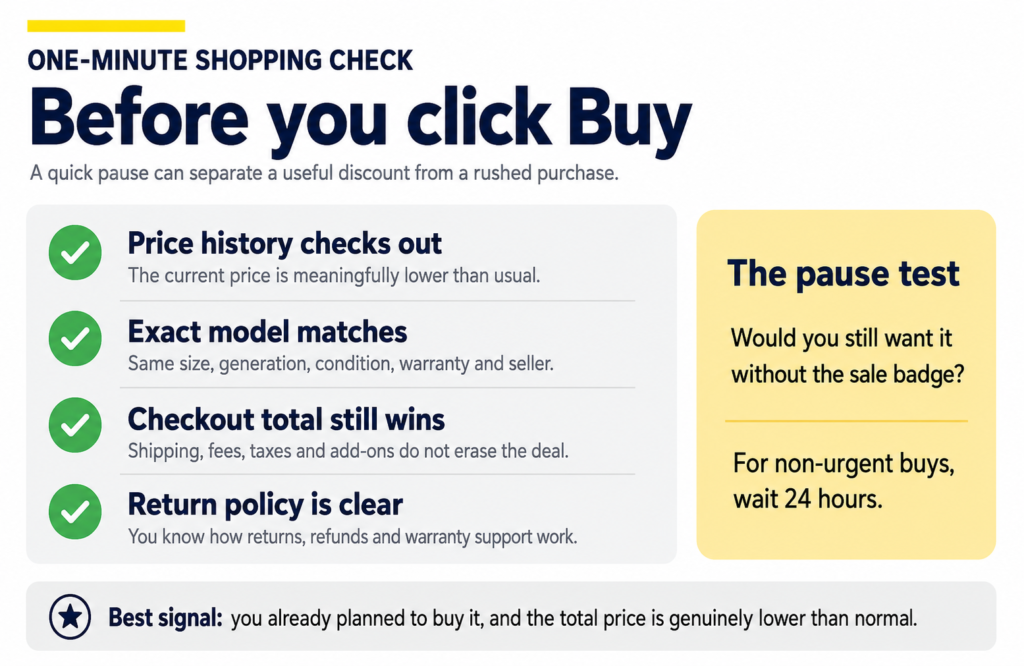
Before checking the percentage off, ask a less exciting question:
Would I still want this if it were not on sale?
If the answer is yes, the deal may be worth evaluating. If the answer is no, the discount is doing most of the work. That does not make the purchase morally wrong. This is not a courtroom for air fryers. It simply changes what is happening.
You are no longer buying because the product solves a clear problem. You are buying because the page created a moment.
That distinction matters because many online deals are built around speed. The page wants you to move from “interesting” to “mine” before the slower part of your brain has time to ask basic questions.
Do I need this?
Is this the exact model I wanted?
Is this price actually unusual?
What happens if I need to return it?
The FTC’s online shopping advice tells consumers to compare products, check sellers, understand total cost, read return and refund policies and keep records of purchases. In other words, the boring steps are not decorations. They are the deal test.
If the offer is strong, it can survive them.
A Real Deal Is Different From a Cheap Price
This is where many purchases get confused.
Cheap means the price is low.
Affordable means the price fits your budget.
Good value means the product gives enough usefulness, quality and lifespan for what it costs.
A good deal means the buying conditions are better than normal: the price is meaningfully lower, the seller is reliable, the terms are clear, and the extra costs do not quietly change the math.
Those four ideas can overlap. They are not the same thing.
A product can be cheap and still a bad value. Think of a $60 printer that uses ink as if each page were a diplomatic document.
A product can be expensive and still good value if it lasts, performs well and solves a problem you deal with every day.
A product can be affordable but not on sale.
And a product can be discounted and still be a bad purchase because you did not need it, the seller is risky, the return policy is terrible or the accessories cost more than the original thrill.
This is the heart of smart buying:
The lowest number on the screen is not always the smallest cost.
The Crossed-Out Price Is Only a Claim
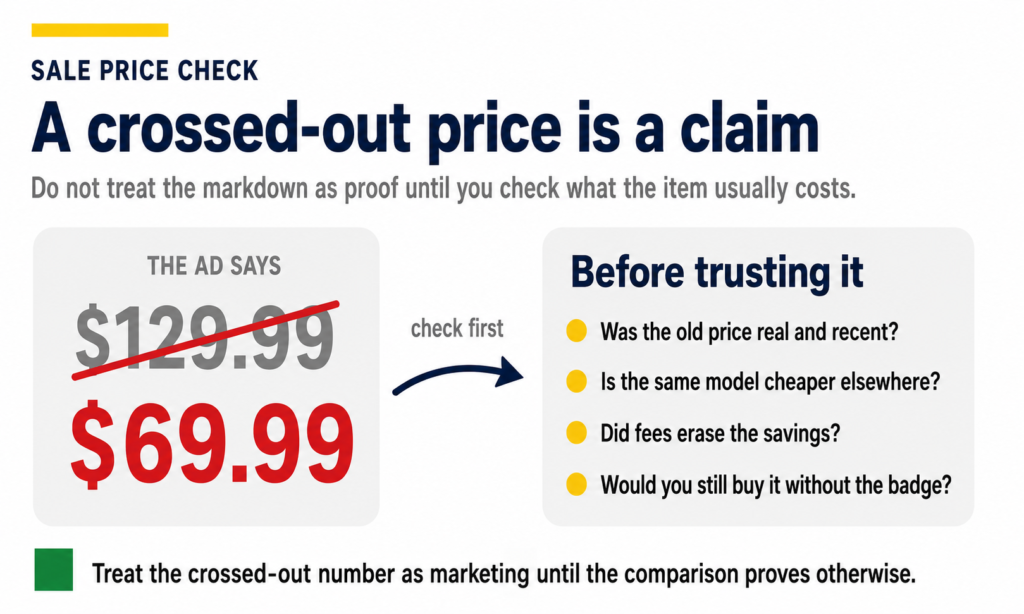
A crossed-out price is a story.
It says: this product used to belong to a more expensive world, and today you have been invited through a side door.
Sometimes that story is true. A retailer may genuinely reduce a product from a recent normal price. But the higher number may also be a list price, a suggested retail price, a short-lived former price or a comparison that does not reflect what shoppers usually pay.
The FTC’s Guides Against Deceptive Pricing explain that a former price comparison is legitimate when the former price was real and offered in good faith for a reasonable period. If a higher price is artificial or inflated to create the appearance of a bargain, the advertised “reduction” can mislead shoppers.
For the reader, the practical lesson is simple:
Do not judge the deal from the markdown alone.
Judge it against recent reality.
If a blender is shown as “$149, now $79,” but it has sold for $89 most of the month, the real savings are closer to $10 than $70. The discount is doing cardio. The price barely moved.
That does not mean the product is a bad buy. It may still be useful at $79. But you should know whether you are seeing a rare discount or a familiar price wearing a sale badge.
Check the Price History Before You Trust the Sale
Price comparison tells you what stores are charging today.
Price history tells you whether today’s price is unusual.
Both matter.
A product can be cheaper than yesterday and still not be a strong deal. It may drop to that price every few weeks. It may have been cheaper last month. It may have gone up shortly before the sale. Or the discount may apply only to one color, one size or one configuration that most buyers do not actually want.
When possible, check:
- the recent normal price;
- the lowest price in the last 30 days;
- the lowest price in the last 90 days;
- whether the current price appears often;
- whether other reputable sellers are close to the same price;
- whether the product rose in price before the promotion.
The goal is not perfection.
You do not need to become a forensic accountant because you wanted headphones. But you do want enough context to know whether the discount is meaningful.
A real deal does not always have to be the lowest price ever. If you need the item now, a strong near-low price from a trustworthy seller may be good enough.
The word “enough” matters. Good buying is not about winning a trophy for maximum savings. It is about making a decision you will still respect after the sale banner disappears.
Confirm the Exact Product Before Comparing Prices
This is where many bad deals hide in plain sight.
Two products can look almost identical and still be meaningfully different. Same brand. Similar photo. Nearly identical name. Different year, model number, storage size, battery capacity, panel type, included accessories, warranty terms or software support.
The discount may be real.
It may also be attached to the version you did not mean to buy.
This is common with:
- TVs;
- laptops;
- phones;
- headphones;
- robot vacuums;
- air fryers;
- mattresses;
- appliances;
- smart home devices;
- refurbished or renewed products.
Before comparing prices, confirm:
- the full model number;
- release year or generation;
- size, capacity and configuration;
- condition: new, used, refurbished, renewed or open-box;
- included accessories;
- warranty length;
- seller or marketplace listing;
- return terms.
The FTC’s marketplace guidance tells shoppers to read item descriptions carefully and pay attention to words such as refurbished, vintage, used, as-is or close-out because they can signal condition differences.
That small detail can change everything.
A cheaper version is not automatically a better value if it lacks the feature that made you want the product in the first place.
Paying less for the wrong item is just a discount on disappointment.
The Seller Matters as Much as the Price

On a marketplace, the product page may show a familiar brand while the actual seller is a third party you have never heard of.
That is not automatically bad. Many third-party sellers are legitimate. But the seller changes the risk, especially for electronics, chargers, batteries, beauty devices, baby products, car accessories, appliances and anything where counterfeits, missing warranties or poor quality could matter.
The FTC advises shoppers to research unfamiliar sellers, check reviews or complaints, review marketplace policies and use safer payment methods when possible. It also warns that unusually low prices on expensive products can be a sign of a scam, especially when the seller is unfamiliar or the ad appears through social media.
Before buying, check:
- the seller name;
- whether the product is sold by the brand, the retailer or a third party;
- recent seller ratings and complaints;
- whether the listing includes contact information;
- return and refund rules;
- who provides the warranty;
- whether the seller is authorized;
- whether payment happens inside the marketplace or outside it.
Be extra careful if a seller wants payment by gift card, wire transfer, payment app or cryptocurrency. The FTC repeatedly warns that scammers often prefer payment methods that make it hard to get money back.
The cleanest version of this rule is blunt:
If the seller is unclear and the discount is unusually large, slow down.
The timer measures time. It does not measure trust.
The Checkout Total Gets the Final Vote
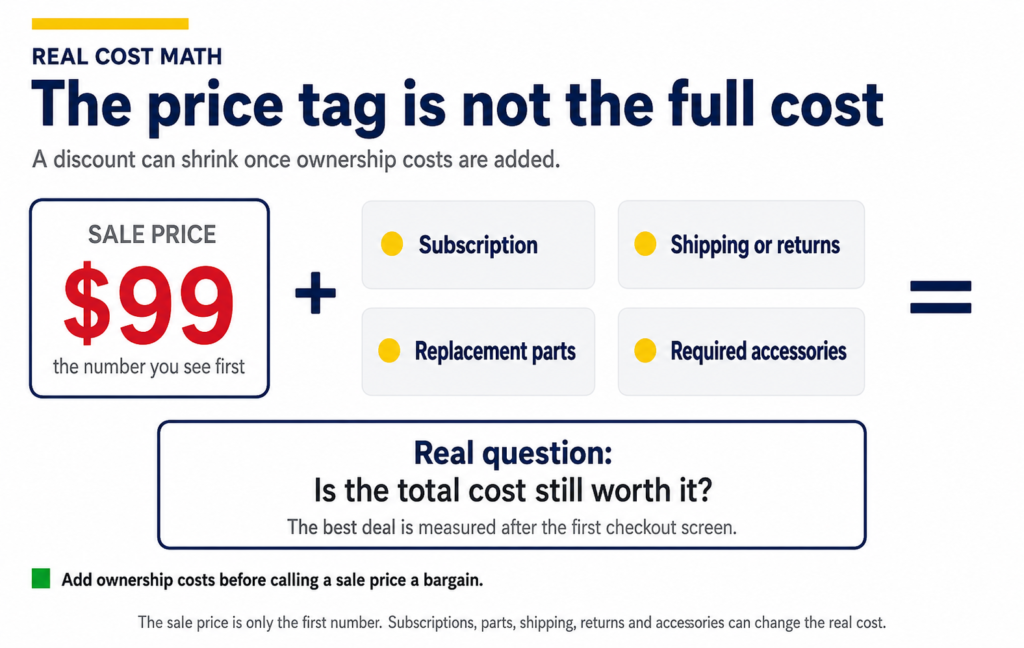
The sale price is only the first number.
Some purchases look cheap until the rest of the buying process arrives with a clipboard.
Shipping. Handling. Installation. Required accessories. Replacement cartridges. Filters. Bags. Batteries. Mounting hardware. Return shipping. Restocking fees. Subscription plans. Extended warranty pressure. Consumables that cost more than anyone mentioned in the headline.
This is why good deal and good value have to meet each other before checkout.
A cheap product may not be good value if it needs expensive parts every month.
A more expensive product may be good value if it lasts longer, avoids recurring costs and performs better for the way you actually use it.
Before buying, ask what the product costs after the first month, not only at checkout.
Common hidden costs include:
- subscriptions;
- replacement filters, bags, cartridges or blades;
- proprietary accessories;
- shipping and delivery fees;
- return shipping;
- restocking fees;
- installation;
- batteries, adapters or mounting hardware;
- repair costs;
- energy use;
- warranty limitations.
That sounds like a lot because ownership is a lot.
The real price is not only the price of buying the product. It is the price of living with it.
Returns and Warranties Are Part of the Deal
Return policies are not paperwork after the purchase. They are part of the purchase.
The FTC advises shoppers to read delivery, return and refund policies before buying, including who pays return shipping, how many days the buyer has to return the item and whether restocking fees apply. It also notes that sale or clearance items may have different return rules.
That last part matters.
A deal with a short return window, high return shipping cost or unclear warranty is weaker than it looks. A slightly higher price from a seller with clear returns and reliable support may be the better deal for certain products.
Check:
- the return window;
- whether opened items can be returned;
- who pays return shipping;
- whether there is a restocking fee;
- whether clearance or sale items are excluded;
- whether the warranty comes from the manufacturer, retailer or third-party seller;
- what records you need to keep;
- how long delivery is supposed to take.
For expensive items, screenshot the offer, price, seller name, return terms and warranty page before buying. Keep confirmation emails and receipts.
That is not paranoia.
That is future-you leaving present-you a paper trail.
Reviews Are Signals, Not a Verdict

Reviews can help. They can also be messy, manipulated, vague or attached to a different version of the product.
The FTC has taken action on fake reviews and testimonials and finalized a rule aimed at combatting fake or misleading review practices. For shoppers, the practical move is to treat reviews as signals, not proof.
Do not stop at the star rating.
Read:
- recent reviews;
- middle-star reviews;
- reviews with photos or specific use cases;
- repeated complaints about the same defect;
- comments about seller behavior, shipping and returns;
- reviews that match the exact model or size;
- updates written after weeks or months of use.
Middle-star reviews often tell the truth with less drama. They are where people say things like, “It works, but…” and the part after “but” is usually what you came to learn.
Be cautious with reviews that are extremely vague, strangely repetitive, overloaded with marketing phrases or disconnected from the actual product.
A review that says “amazing product, changed my lifestyle, very premium feeling” may be honest.
It may also be a fog machine with punctuation.
Three Red Flags That the Sale Price Is Doing Too Much Work
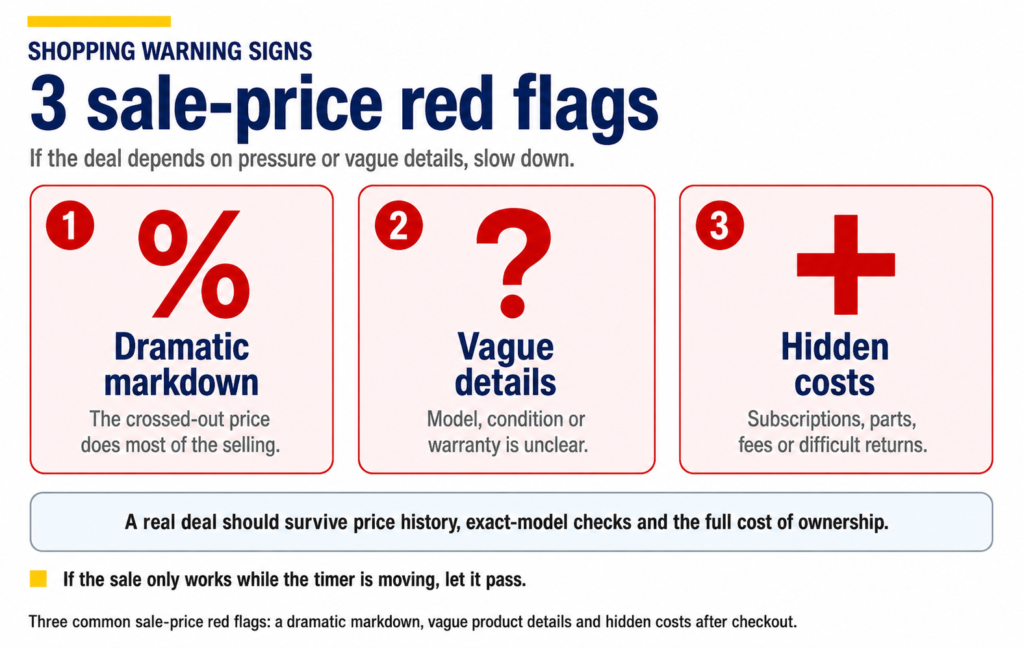
You do not need to investigate every product for an hour. Sometimes a few signals are enough to tell you to slow down.
The “Before” Price Does Not Match Reality
If the sale depends on a dramatic crossed-out price, check whether that higher price appears in recent history. A product that is “70% off” every other week is not really inviting you to a rare event. It is operating on a schedule.
The discount may still be real in the ad.
It may also be irrelevant in practice.
The Product Is Always Urgent
Countdown timers, low-stock warnings and “limited time” messages can be legitimate. They can also be pressure tools. The FTC’s dark patterns report discusses how design tactics, including misleading countdown timers, can interfere with consumer choice.
Treat urgency as a reason to verify, not to rush.
If the product is useful, the exact model is clear, the price is strong, and the seller is trustworthy, the deal can survive your pause.
If it collapses the moment you stop moving, that tells you something.
The Final Cost Grows After the Sale Badge
A discount that disappears into shipping, accessories, fees, subscriptions or return costs is not much of a discount.
The checkout page is where the deal stops performing and starts doing math.
Let it.
Cheap Can Be the Right Choice
This guide is not an argument for always spending more.
Cheap can be the smartest option when the product is simple, low-risk and easy to replace. A basic notebook, storage bin, occasional-use tool, simple travel pouch or seasonal item may not need premium materials or long-term support.
Paying more for a feature you will never use is not sophistication. It is just a more expensive version of clutter.
Buying cheap can make sense when:
- the product is low-risk;
- you will use it occasionally;
- replacement is easy;
- the performance standard is simple;
- safety is not a major concern;
- there are no expensive recurring costs;
- reviews show the trade-offs clearly.
The trick is not to worship the lowest price.
It is to match the price to the job.
Paying More Can Also Be the Better Deal
Paying more can be smart when the extra money buys durability, safety, comfort, reliability, repairability, better support or lower ownership costs.
This is especially true for products you use often or depend on heavily: laptops for work, mattresses, office chairs, luggage for frequent travel, appliances, chargers, batteries, power strips, car seats, tools and certain home products.
But even here, the rule is not “expensive is better.”
The rule is: pay more only when the extra money buys something you will actually use, feel or need.
Paying twice as much for twice the lifespan may be good value.
Paying twice as much for a feature you will never touch is simply paying twice as much.
The HFD Deal Test Before You Click
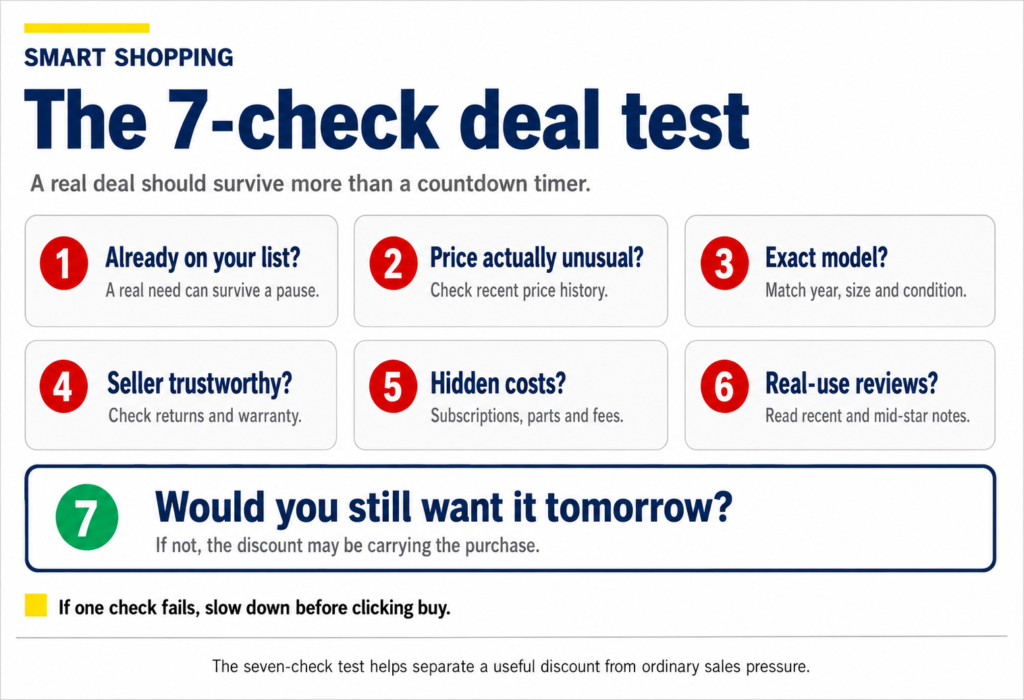
Before buying, run the product through this final filter.
Was It Already on Your List?
A real need can survive a pause. A sale-created desire often cannot.
Is the Current Price Actually Unusual?
Check price history and compare reputable sellers.
Is This the Exact Model You Want?
Confirm model number, year, size, capacity, condition, accessories and warranty.
Is the Seller Trustworthy?
Check who sells it, who ships it, who handles returns and who backs the warranty.
Does the Final Cost Still Work?
Include shipping, taxes, subscriptions, replacement parts, accessories, return costs and installation.
Do Reviews Show Real Use?
Read recent, specific and middle-star reviews. Look for patterns, not just praise.
Would You Still Want It Tomorrow?
If the answer is no, the discount may be carrying the whole purchase.
A Real Deal Makes the Decision Clearer
The checkout page is where the deal stops performing and starts doing math.
The best deal is not always the cheapest price, the largest discount or the loudest banner.
It is the purchase that still makes sense after the pressure is removed.
After you check the product, seller, price history, total cost, reviews, returns and warranty, one of three things usually happens.
The deal gets stronger because the evidence supports it.
The deal gets weaker because the savings were mostly cosmetic.
Or the deal becomes irrelevant because you realize you were about to buy a solution to a problem you did not have yesterday.
All three outcomes are useful.
Buying nothing is not a failure. Waiting is not a failure. Paying more for the right item is not a failure. Buying the cheaper version is not a failure if it does the job.
The goal is not to make every purchase perfect.
The goal is to make the decision clearer before your money leaves.
That is what a real deal should do. It should not only reduce the number on the screen. It should help you buy something useful, from a trustworthy place, at a price that fits your life.
FAQ
How do I know if an online deal is real?
Check whether the product was already useful to you, compare recent price history, confirm the exact model, review the seller, calculate total cost and read return and warranty terms before buying.
Is a crossed-out price reliable?
Not by itself. A crossed-out price may be a real former price, but it may also be a list price, suggested price or inflated comparison. Use price history and reputable seller comparisons before trusting the markdown.
What is the difference between cheap and good value?
Cheap means the price is low. Good value means the product gives enough usefulness, durability, support and lifespan for what it costs. A cheap item can be good value, but it is not automatic.
What is the biggest red flag in a sale price?
The biggest red flag is a dramatic discount that does not match recent price history, especially when the exact model, seller or return terms are unclear.
Should I buy when the countdown timer is almost over?
Only if the product has already passed your checks. A countdown timer should not replace price history, seller research, model comparison or return-policy review.
What hidden costs should I check before buying?
Look for shipping, taxes, return shipping, restocking fees, subscriptions, replacement parts, required accessories, batteries, installation, repairs and warranty limits.
Internal Links
External Sources
- FTC Consumer Advice – Online Shopping: https://consumer.ftc.gov/articles/online-shopping
- FTC Consumer Advice – Buying From an Online Marketplace: https://consumer.ftc.gov/articles/buying-online-marketplace
- FTC Consumer Advice – Don’t let scammers get in the way of your holiday shopping: https://consumer.ftc.gov/consumer-alerts/2024/11/dont-let-scammers-get-way-your-holiday-shopping
- FTC – Bringing Dark Patterns to Light: https://www.ftc.gov/reports/bringing-dark-patterns-light
- eCFR – 16 CFR Part 233, Guides Against Deceptive Pricing: https://www.ecfr.gov/current/title-16/chapter-I/subchapter-B/part-233
- FTC – Final Rule on Fake Reviews and Testimonials: https://www.ftc.gov/business-guidance/resources/federal-trade-commission-announces-final-rule-combatting-fake-reviews-testimonials
- CFPB – Financial well-being: The goal of financial education: https://www.consumerfinance.gov/data-research/research-reports/financial-well-being/
