
Buying guides
Cheap vs. Good Value: How to Tell the Difference Before You Buy
Cheap means a lower price today. Good value means the product fits your use, avoids hidden costs and still feels smart after you use it.
Editorial illustration created for HFD.
Cheap is about the price you pay today. Good value is about what you get for that money after the first few weeks, months or years of use.
The short answer: a cheap product is only a good value if it does the job well enough, lasts long enough, avoids expensive hidden costs and fits the way you will actually use it.
Why it matters: online shopping makes low prices look like obvious wins. A product can be marked down, promoted, bundled or pushed by a countdown timer, but none of that tells you whether it will still feel like a good buy after the return window closes.
This is the difference HFD will use across future buying guides: we are not looking for the lowest price in isolation. We are looking for the most sensible purchase for the reader’s use case.
For a broader buying filter, start with HFD’s guide to how to spot a real deal before you click buy.
Cheap Means Lower Price. Good Value Means Better Fit.
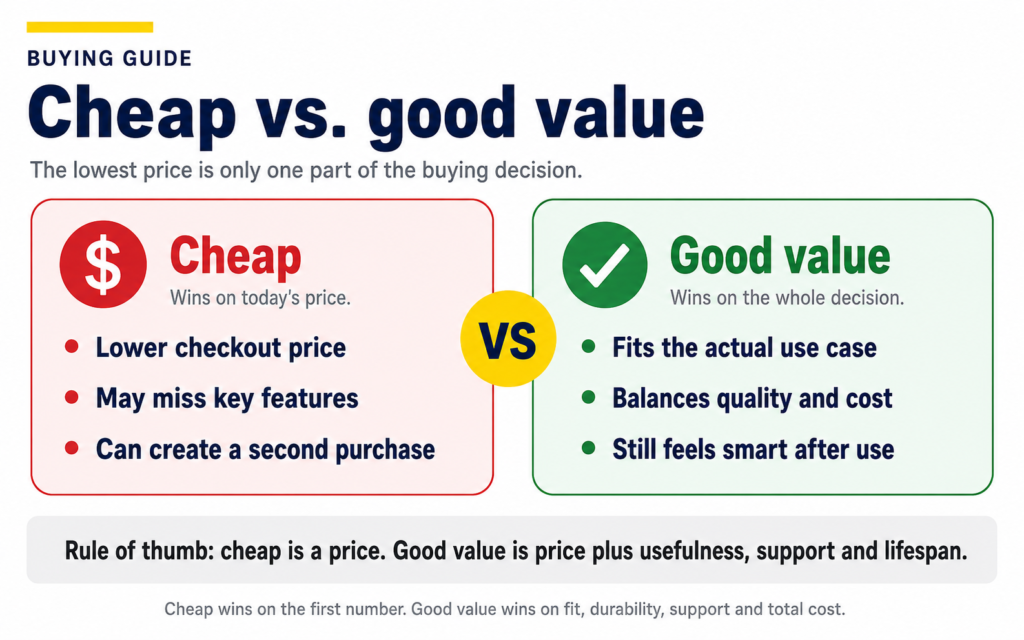
A cheap product wins on the first number. A good-value product wins on the whole decision.
That means the lowest price can be the right answer sometimes. A basic charging cable, storage bin, notebook, kitchen tool or travel accessory may not need premium materials or advanced features. If the product is simple, low-risk and easy to replace, cheap can be enough.
The catch: cheap becomes a problem when the low price creates a second purchase. If a product breaks quickly, lacks the feature you needed, needs costly accessories or creates frustration every time you use it, the real price is higher than the checkout total.
Good value usually sits in the middle. It is not always the cheapest and not always the most expensive. It is the option that gives you the best balance of usefulness, durability, support and cost.
The Five Questions That Reveal Value
Before you call something a good buy, ask five questions.
1. Will I Use It Often Enough?
Frequency matters. A $20 product used twice may be worse value than a $90 product used every week.
This is especially true for kitchen appliances, fitness gear, travel accessories, smart home devices and home organization products. The more often you use something, the more comfort, durability and reliability matter.
2. Does It Have The Feature I Actually Need?
Cheap products often look close enough until one missing feature becomes the whole problem.
A cheaper laptop may have too little storage. A cheaper robot vacuum may lack mapping. A cheaper suitcase may have weak wheels. A cheaper air fryer may be too small for the meals you actually cook.
What to check: identify the one or two features that matter most before you look at price.
3. What Happens If It Breaks?
Value includes support.
Look at warranty length, return policy, seller reputation and whether replacement parts are easy to find. A low-cost product with no support can be fine for simple items. For electronics, appliances, baby products, car accessories and anything safety-related, support matters much more.
4. Are There Hidden Costs?
Some products are cheap because the money comes later.
Examples include subscriptions, filters, cartridges, replacement bags, proprietary accessories, batteries, installation, shipping and return fees.
Reality check: a product is not automatically a bargain because the first payment is low.
5. Do Real Reviews Show The Same Trade-Offs?
Reviews are useful when they describe real use.
The FTC has warned about fake reviews and testimonials, so shoppers should look for patterns rather than trusting the rating alone. Recent reviews, middle-star reviews and repeated complaints often reveal more than the headline score.
If many buyers mention the same weakness, treat it as part of the price.
When Cheap Is The Right Choice
Cheap can be smart when the purchase is low-risk and the product does not need to last forever.
Good examples:
- simple storage items;
- basic office supplies;
- temporary travel accessories;
- backup cables from reliable sellers;
- seasonal decorations;
- simple tools for occasional use.
The key is not to overbuy. Paying premium prices for a product you rarely use can be just as wasteful as buying the cheapest version of something important.
When Paying More Makes Sense
Paying more can be the better value when the product affects comfort, safety, time or long-term cost.
Examples:
- mattresses and office chairs;
- chargers, batteries and power strips;
- appliances used every week;
- luggage for frequent travel;
- car seats or safety-related gear;
- laptops and phones used for work;
- tools that need to be reliable.
The bottom line here is not “buy expensive.” It is “pay more only when the extra money buys something you will actually feel or use.”
The HFD Good-Value Test
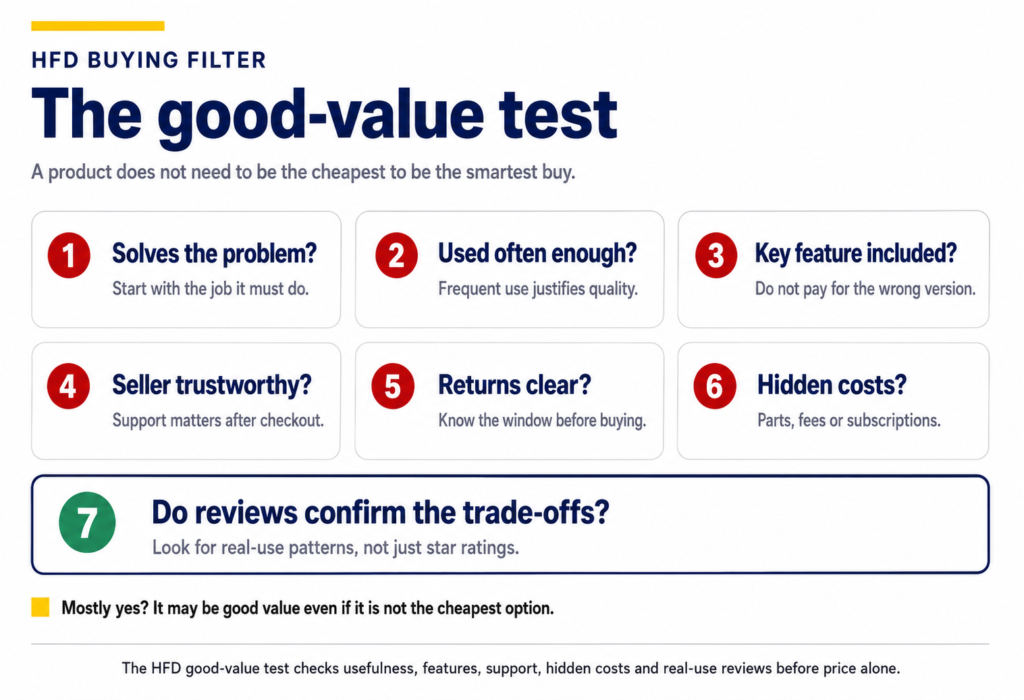
Use this quick test before buying:
- Does it solve the exact problem I have?
- Will I use it often enough?
- Does it have the feature that matters most?
- Is the seller trustworthy?
- Are returns and warranty clear?
- Are there hidden costs?
- Do recent reviews confirm the trade-offs?
If the answer is mostly yes, the product may be a good value even if it is not the cheapest option.
The Bottom Line
Cheap is a price. Good value is a decision.
Before buying, look beyond the discount and ask whether the product fits your real use, has the features you need, avoids hidden costs and comes from a seller you trust.
The best buy is not the one that costs the least. It is the one that still feels smart after you have used it.
FAQ
Is cheap always bad?
No. Cheap can be smart for simple, low-risk products that do not need premium features or long-term support.
Is expensive always better value?
No. A more expensive product is only better value if the extra cost buys useful quality, durability, comfort, support or features you will actually use.
How do I know if a product is good value?
Compare price, useful features, expected lifespan, seller trust, return terms, hidden costs and real user reviews.
What is the biggest mistake shoppers make?
The biggest mistake is treating the lowest price as the best deal without checking total cost, product fit and real-world use.
External Sources
- FTC Consumer Advice – Shopping and Donating: https://consumer.ftc.gov/consumer-alerts/shopping-and-donating
- FTC – Bringing Dark Patterns to Light: https://www.ftc.gov/reports/bringing-dark-patterns-light
- FTC – Final Rule Combatting Fake Reviews and Testimonials: https://www.ftc.gov/business-guidance/resources/federal-trade-commission-announces-final-rule-combatting-fake-reviews-testimonials