
Buying guides
3 Red Flags That a Sale Price Is Not Really a Deal
Before you trust a sale price, check whether the crossed-out price is meaningful, the exact product is clear and hidden costs do not erase the savings.

Imagem de Анастасия por Pixabay
A sale price can look convincing before it is useful. The fastest way to slow down is to look for the few signals that usually separate a real discount from a purchase you may regret.
The short answer: be careful when the crossed-out price is doing most of the work, the exact product details are unclear or the checkout total changes the math.
Why it matters: online sale pages are designed to create momentum. A big markdown, a short timer and a bright badge can make a product feel like a decision you need to make quickly. But a deal that cannot survive a slower check is not much of a deal.
For the full buying filter, read HFD’s guide to how to spot a real deal before you click buy. For the pricing side specifically, see how to tell if a sale price is actually a good deal.
Red Flag 1: The Crossed-Out Price Looks Too Dramatic
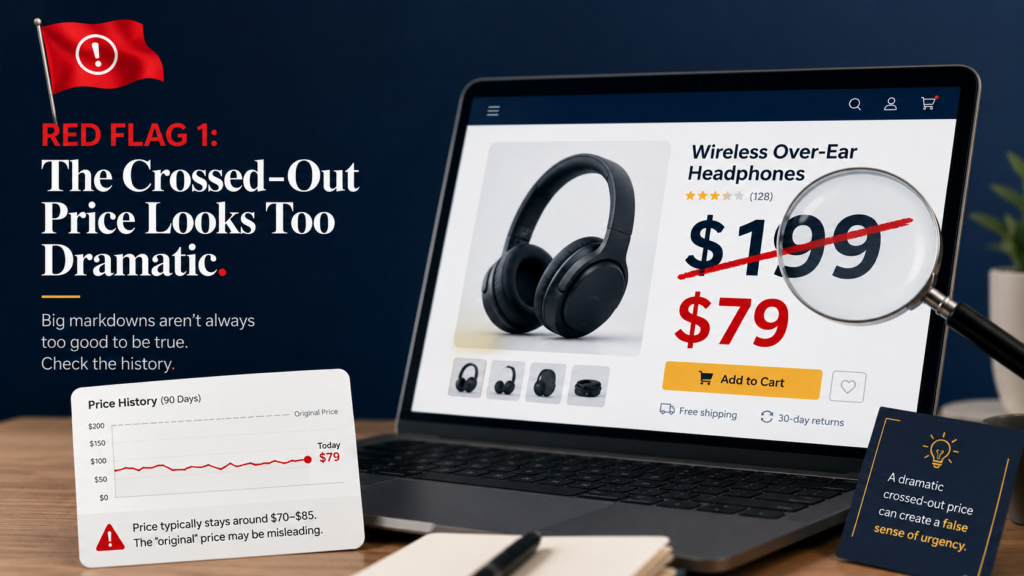
A crossed-out price can be useful context. It can also be the entire sales pitch.
If a product says it dropped from $199 to $79, the discount looks huge. But the better question is whether shoppers were actually paying anything close to $199 recently. A former price, list price or suggested retail price may not reflect the product’s normal real-world price.
The FTC’s pricing guides warn that former-price comparisons can mislead shoppers when the higher price is not genuine or meaningful.
What to check: compare the current sale price with recent price history and other reputable stores. If the product regularly sells near the sale price, the markdown is more theater than savings.
Reality check: a sale price does not need to be the lowest price ever to be useful. But you should know whether the discount is rare, ordinary or mostly cosmetic.
Red Flag 2: The Product Details Are Vague
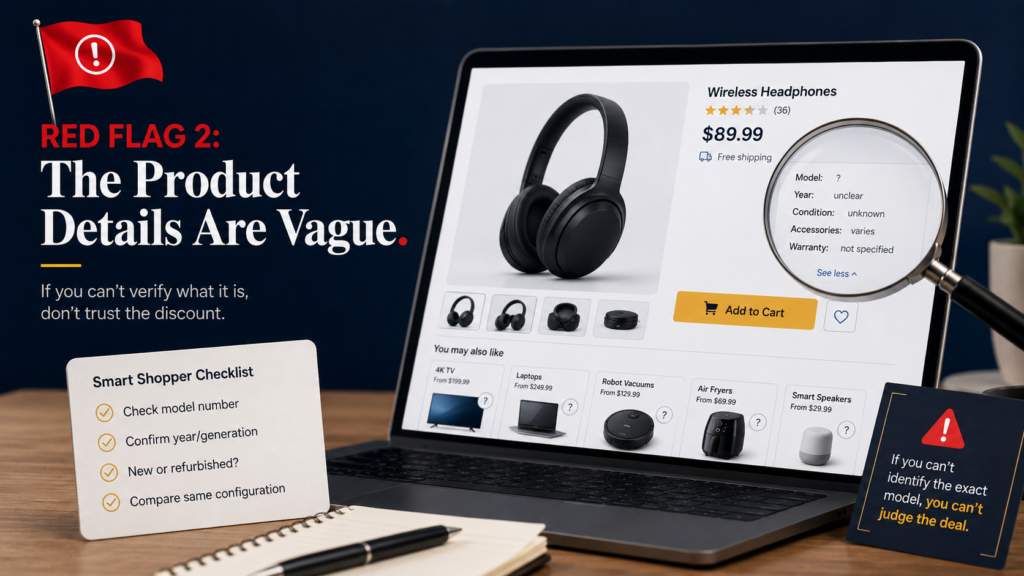
Unclear product details are where a lot of bad deals hide.
A listing may show a familiar product type, a strong discount and plenty of attractive photos, but still leave out the exact model number, release year, condition, warranty terms or included accessories. That matters because two products can look almost identical and perform very differently.
This is especially common with:
- TVs;
- laptops;
- headphones;
- robot vacuums;
- air fryers;
- mattresses;
- smart home devices;
- refurbished or renewed products.
The catch: if the listing does not make the exact model clear, you cannot compare the price properly.
What to check: search the model number, confirm the year or generation, check whether it is new or refurbished and compare the same configuration at another reputable seller.
If you cannot confirm what you are buying, the discount is not ready to be trusted.
Red Flag 3: The Final Cost Is Higher Than The Sale Price
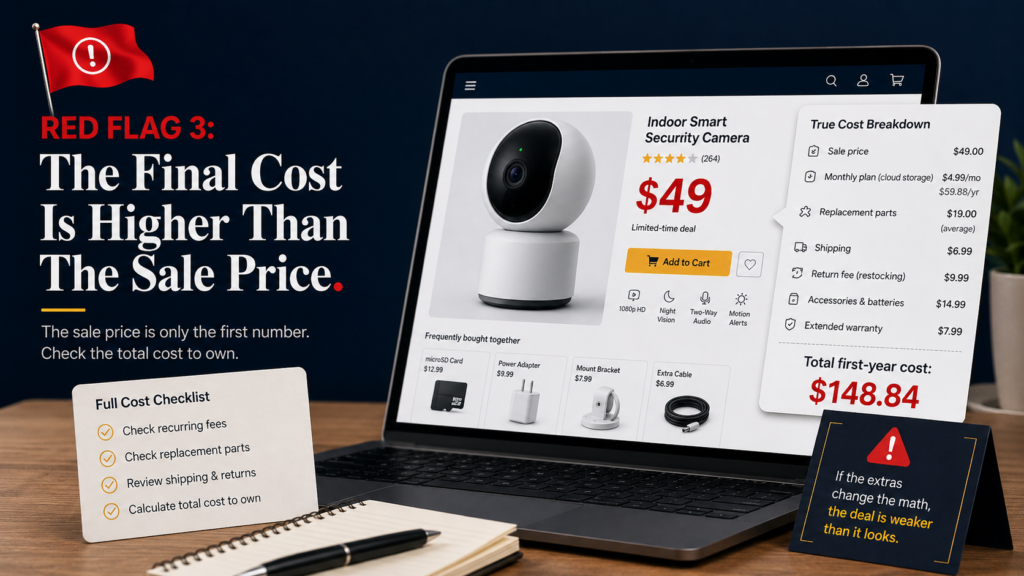
The sale price is only the first number.
Some products look cheap at checkout and become expensive later. The extra cost may come from subscriptions, replacement parts, required accessories, shipping, return shipping, restocking fees, installation or warranty pressure.
Examples:
- a cheap printer with expensive ink;
- a smart camera that needs a monthly plan;
- a robot vacuum with costly replacement bags;
- a low-cost appliance with difficult returns;
- a travel accessory that needs separate adapters or batteries.
The question is not only “Is this cheaper today?” The better question is “What will this cost to own?”
What to check: look at the checkout total, return policy, warranty and any recurring or replacement costs before buying.
The Quick HFD Sale-Price Filter
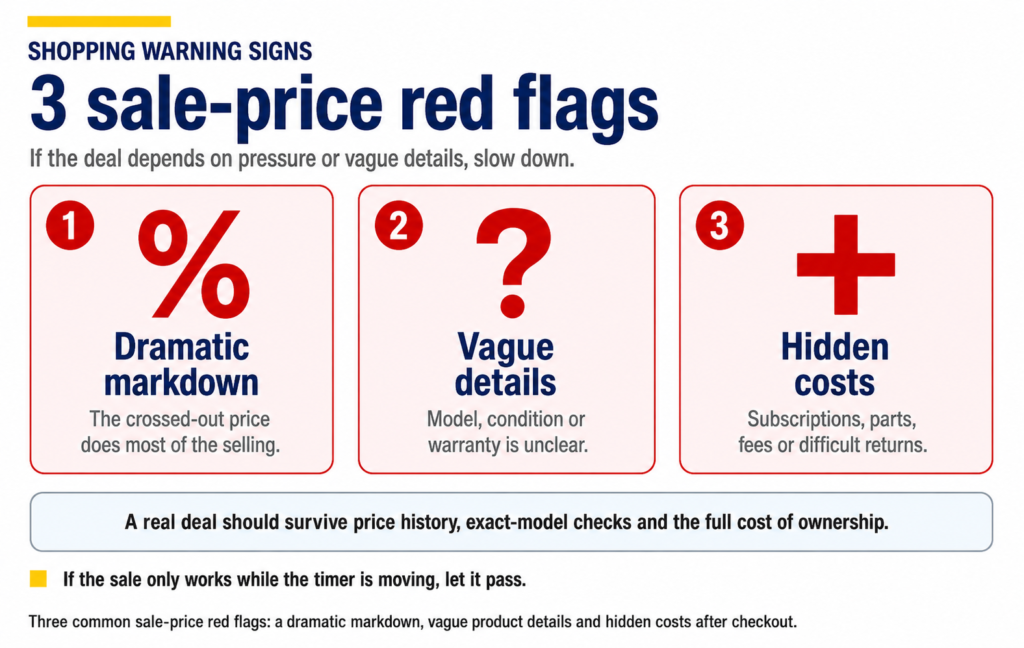
Before you click buy, ask:
- Was this product already on my list?
- Is the sale price lower than its recent normal price?
- Is the exact model clear?
- Is the seller trustworthy?
- Are returns and warranty clear?
- Are there hidden costs after checkout?
- Would I still want this tomorrow?
If the answer to several of those is no, the sale price is probably not doing you a favor.
The Bottom Line
A real deal should not depend entirely on urgency, a dramatic crossed-out price or vague product details.
Before buying, check the recent price, the exact model and the full cost of owning the product. If the sale still looks good after those checks, it may be worth considering.
If the deal only works while the timer is moving, let it pass.
FAQ
What is the biggest red flag in a sale price?
The biggest red flag is a dramatic crossed-out price that does not match recent price history or other reputable sellers.
How do I check if a sale price is real?
Compare recent price history, search the exact model number, check reputable sellers and review the final checkout cost.
Are sale prices always misleading?
No. Many sale prices are real. The goal is to check whether the discount is meaningful for the exact product you want.
Should I buy if the timer is almost over?
Only if the product already passed your checks. A countdown timer should not replace price history, model comparison or return-policy review.
External Sources
- eCFR – 16 CFR Part 233, Guides Against Deceptive Pricing: https://www.ecfr.gov/current/title-16/chapter-I/subchapter-B/part-233
- FTC – Bringing Dark Patterns to Light: https://www.ftc.gov/reports/bringing-dark-patterns-light
- FTC – Final Rule Combatting Fake Reviews and Testimonials: https://www.ftc.gov/business-guidance/resources/federal-trade-commission-announces-final-rule-combatting-fake-reviews-testimonials