
Uncategorized
What Travelers Should Check Before Booking a Cheap Flight
The Cheap Flight Is Not Always the Best Flight

Image by Joshua Woroniecki via Pixabay
A cheap flight can be a win. It can also be a trap with a boarding pass.
Why This Matters

Flight search pages are built to make one number feel decisive.
You enter a route. The results sort by price. One fare sits at the top, sometimes much lower than the rest. It is tempting to treat that number as the answer.
But airfare is rarely just airfare anymore.
The cheapest result may use a worse airport, arrive after midnight, include a risky connection, exclude carry-on baggage, charge more for seats or make changes difficult. A fare that looks $80 cheaper can become more expensive once the real trip is counted.
That does not mean cheap flights are bad. Some are genuinely excellent. The point is simpler: the cheapest fare is only the starting price of a travel decision.
The better question is not “What is the lowest fare?”
The better question is: What will this trip actually cost me in money, time and stress?
The Short Answer
A cheap flight is a good deal when it passes six checks:
- the final price is still lower after baggage, seats and fees;
- the airports work for your real schedule;
- the connection is realistic;
- the fare rules match your risk tolerance;
- the airline’s service commitments are acceptable;
- the trip still feels worth it if something goes wrong.
If the fare only looks good before the details are added, it is not really the cheapest flight. It is just the cheapest first screen.
A low fare is useful only when the full trip still works.
Start With the Total Price, Not the Fare
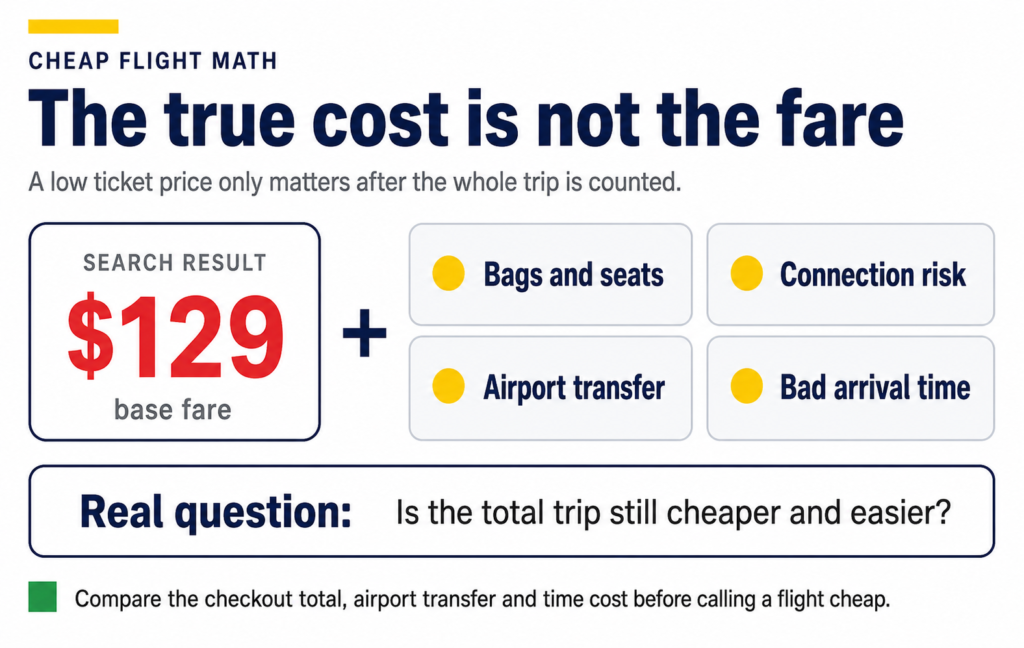
The first number you see is not always the number you will pay.
Some fares include a carry-on bag. Some do not. Some include seat selection. Some charge extra. Some make changes easier. Others save money upfront by removing flexibility.
Before booking, compare the full checkout price.
- carry-on baggage;
- checked baggage;
- seat selection;
- taxes and mandatory fees;
- payment or booking fees;
- change and cancellation rules;
- airport transfer costs;
- overnight hotel risk if the arrival is too late.
A $129 fare can beat a $179 fare if both include what you need. But if the cheaper fare adds $45 for a carry-on, $38 for a seat and a longer airport transfer, the math changes fast.
Check the Airport, Not Just the City

Cheap flights sometimes use alternate airports.
That can be fine. In some cities, the secondary airport is convenient. In others, it can add a long train ride, a costly taxi or a stressful connection to the rest of your trip.
- how far the airport is from where you are staying;
- public transit hours;
- taxi or rideshare costs;
- late-night arrival options;
- whether the airport is easy for your return trip;
- whether bad traffic could erase the savings.
The cheapest flight to “Paris,” “London,” “New York” or “Miami” may not be the cheapest way to reach the place you actually need to be.
Treat Tight Connections as a Cost
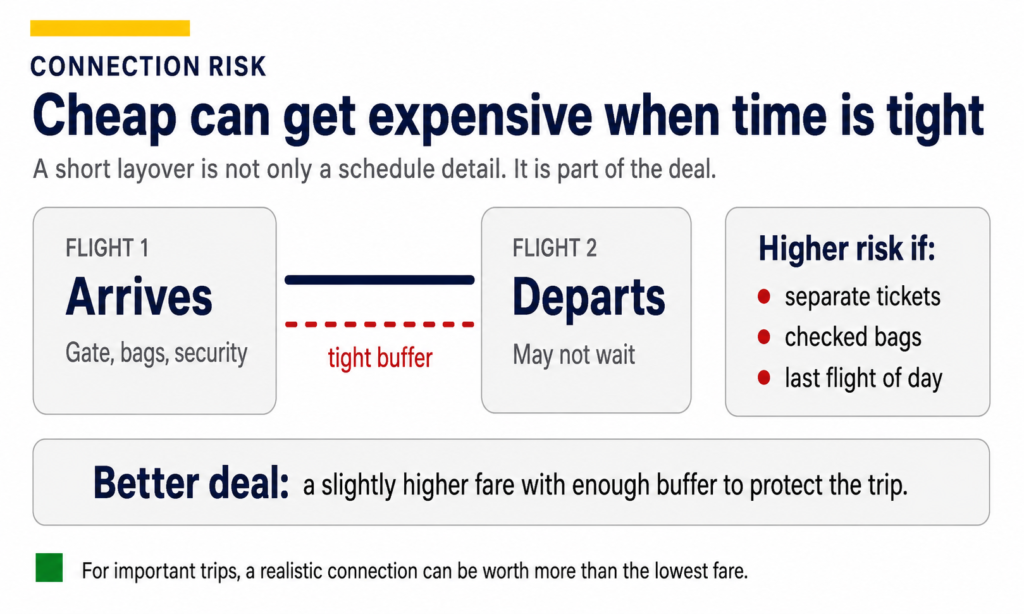
A short connection can look efficient. It can also turn a cheap itinerary into a fragile one.
The risk depends on the airport, airline, weather, customs, terminal layout and whether both flights are on one ticket.
- separate tickets;
- international arrivals followed by domestic departures;
- checked bags;
- large airports with terminal changes;
- winter weather routes;
- last flights of the day;
- connections under an hour.
If both flights are on one ticket, the airline usually has more responsibility to rebook you when a delay breaks the connection. If you create your own connection with two separate bookings, you may carry more of the risk.
Know What Your Fare Class Removes
Many cheap fares are cheap because something has been removed.
That might be flexibility. It might be baggage. It might be seat choice. It might be the ability to board early enough to find overhead bin space.
- Can I bring a full-size carry-on?
- Can I choose a seat?
- Can my family sit together?
- Can I change the flight?
- What happens if I need to cancel?
- Do I earn miles or status credit?
- Am I last to board?
If you are taking a short solo trip with a backpack, the cheapest fare may be perfect. If you are traveling with children, luggage or a fixed event, the same fare can be a bad fit.
Check Refund and Delay Protections
Travelers should know the basic passenger-rights landscape before booking.
The U.S. Department of Transportation has emphasized automatic refunds when airlines cancel or significantly change flights and the passenger does not accept alternative transportation or travel credits. DOT also maintains an Airline Customer Service Dashboard where travelers can compare airline commitments for issues such as meals, hotels and rebooking during controllable disruptions.
- what the airline promises during controllable delays;
- whether hotel or meal support is offered;
- how easy it is to request help;
- whether the ticket is refundable or changeable;
- what happens if the airline changes the schedule.
This matters most when the cheap fare is on a route with limited backup options. A low fare on a once-a-day flight can become expensive if the trip falls apart.
Do Not Ignore the Arrival Time
An arrival time can be part of the cost.
Flights that land very late or very early are often cheaper for a reason. They may save money on airfare while adding inconvenience elsewhere.
- fewer trains or buses;
- higher rideshare prices;
- closed rental car counters;
- hotel check-in complications;
- less sleep before work or an event;
- fewer food options at the airport.
If the cheap flight forces a 4 a.m. wake-up, a $70 taxi or a lost vacation day, the savings may be smaller than they look.
Compare Time, Not Just Money
A cheaper flight with a long layover can be worth it. It depends on how much time you are giving up.
A useful test: how much am I saving per extra hour?
If a flight saves $40 but adds five hours, that is $8 per hour. If it saves $300 and adds three hours, the tradeoff may look better.
Watch for Separate Tickets and Self-Transfers
Some search results combine flights that are not protected as one itinerary.
This can happen with self-transfer trips, mixed airlines or third-party booking platforms. The fare may be cheaper because the traveler is taking on more coordination risk.
- collect and recheck bags;
- go through immigration;
- change airports;
- check in again;
- pass security again;
- rely on the first flight arriving exactly on time.
Check Documents Before the Deal Expires
A flight deal is not useful if you cannot board.
- passport validity;
- visa or entry requirements;
- transit visa rules;
- domestic ID requirements;
- name spelling;
- REAL ID or acceptable identification for U.S. domestic travel.
TSA guidance says travelers need acceptable identification at airport checkpoints. For U.S. domestic flights, REAL ID enforcement began in 2025, but TSA also lists other acceptable forms of identification.
When a Cheap Flight Is Probably Worth It
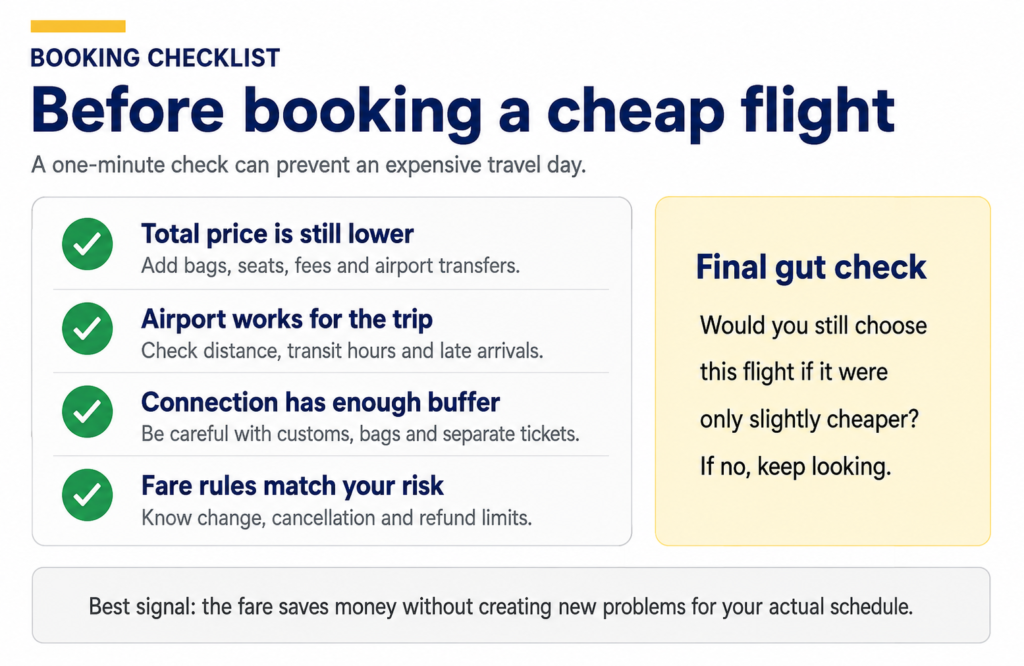
A cheap flight is more likely to be a real win when:
- it is on the airline’s own site or a reliable booking platform;
- baggage rules match how you actually travel;
- the airport is convenient;
- the connection has a reasonable buffer;
- arrival and departure times work;
- the fare is not hiding major restrictions;
- there are other flights that day if something goes wrong;
- you were already planning to take the trip.
That last point matters. A cheap flight is not automatically a reason to travel. The best deals are usually on trips you already wanted to take.
When to Walk Away
Walk away or pause if:
- the final price keeps rising at checkout;
- the airport transfer erases the savings;
- the connection is too tight;
- the itinerary uses separate tickets without enough buffer;
- the fare does not include the bag you need;
- cancellation rules are too strict for your plans;
- the arrival time creates new costs;
- the booking site makes rules hard to understand.
What to Expect From Flight Booking Next
Flight shopping is likely to become more personalized and more fragmented.
Expect more app-only deals, more bundled fare families, more AI-powered trip planning, more dynamic pricing and more add-ons presented during checkout. Airlines and travel platforms will keep trying to sell the trip in pieces: fare, bag, seat, priority boarding, insurance, hotel, rental car and experience.
The traveler response is not to panic. It is to slow the booking down.
Compare the final price. Check the airline site. Read the fare rules. Look at airport transfers. Make sure the connection is realistic. Then decide whether the cheap flight is cheap in real life, not just on the search results page.
Bottom Line
The cheapest flight is not always the best flight.
A low fare is worth booking when the total trip still works after baggage, seats, airport choice, connection risk, arrival time and refund flexibility are counted.
If the fare saves money without creating new problems, take the win.
If the savings disappear once the real trip is added up, the better deal may be the flight that costs more on the first screen and less in your actual life.
FAQ
Is it safe to book the cheapest flight?
Sometimes. The cheapest flight can be a good deal if the airline, timing, baggage rules, airport and connection all work for your trip.
Are basic economy fares worth it?
They can be worth it for short, simple trips with light luggage. They are less attractive when you need flexibility, seat choice, family seating or a full carry-on.
Should I book through an airline or a third-party site?
Both can work, but airline-direct bookings are often simpler when schedules change or disruptions happen. If using a third-party site, read the change, cancellation and support rules carefully.
How much connection time is enough?
It depends on the airport, route and whether the trip is domestic or international. Add more time for checked bags, customs, terminal changes and separate tickets.
What is the best way to compare cheap flights?
Compare the total cost and the total trip, not only the fare. Include baggage, seats, airport transfers, timing, connection risk and refund flexibility.
Sources
- U.S. Department of Transportation – Airline Customer Service Dashboard
- U.S. Department of Transportation – Automatic refunds final rule announcement
- U.S. Department of Transportation – Aviation consumer protection
- TSA – Identification
