
Money
Could South Korea’s Market Crash Break the Global Economy?
South Korea's market crash was not just a local selloff. It showed how a real AI boom can become fragile when concentration, leverage, and investor pressure all move in the same direction.
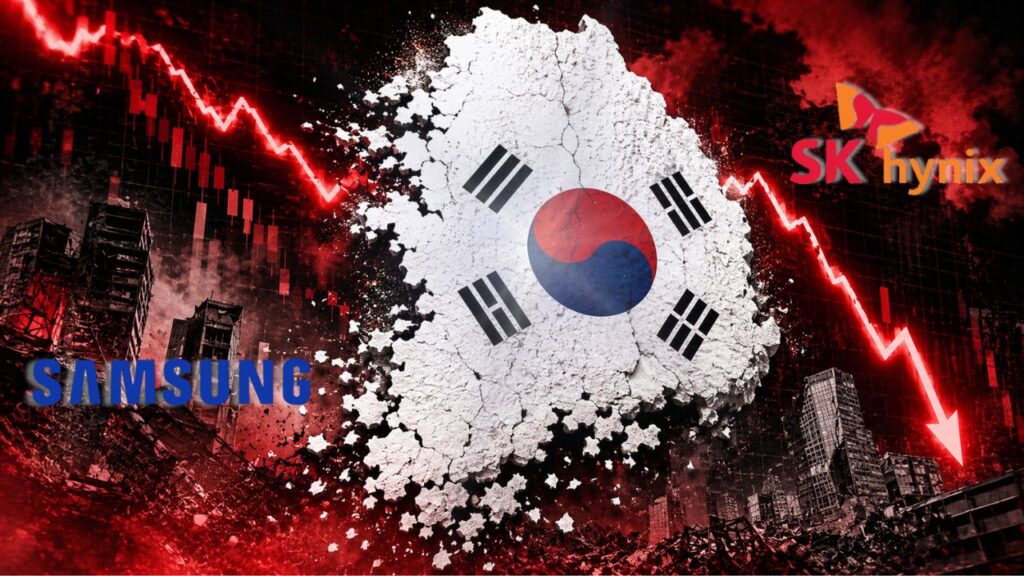
South Korea’s market crash exposed the risk behind concentrated AI chip trades.
At first, South Korea looked like the market everyone wanted to own.
Stocks were rising. The AI story was working. Samsung Electronics and SK Hynix were sitting near the center of the global chip supply chain, and investors had a simple reason to believe: if artificial intelligence needed more computing power, and that computing power needed advanced memory, then South Korea had two companies standing right where the money would flow.
For a while, that was enough.
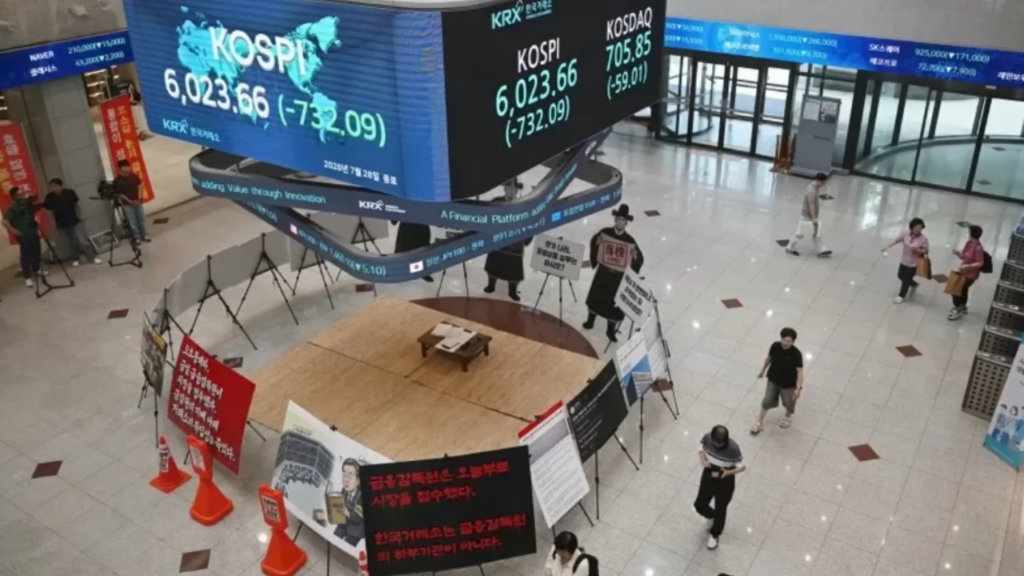
Then the leverage started to unwind.
And once that happened, the story stopped being just about Korea.
The warning from Seoul is not that the AI boom is fake. It is that even a real boom can become dangerous when too many people crowd into the same trade, pay too much for it, and borrow money to make the bet bigger.
The companies can be strong and the structure can still be fragile.
That is the part investors hate learning the hard way.
The Rally Looked Safer Than It Was
South Korea’s market surge had real fuel behind it.
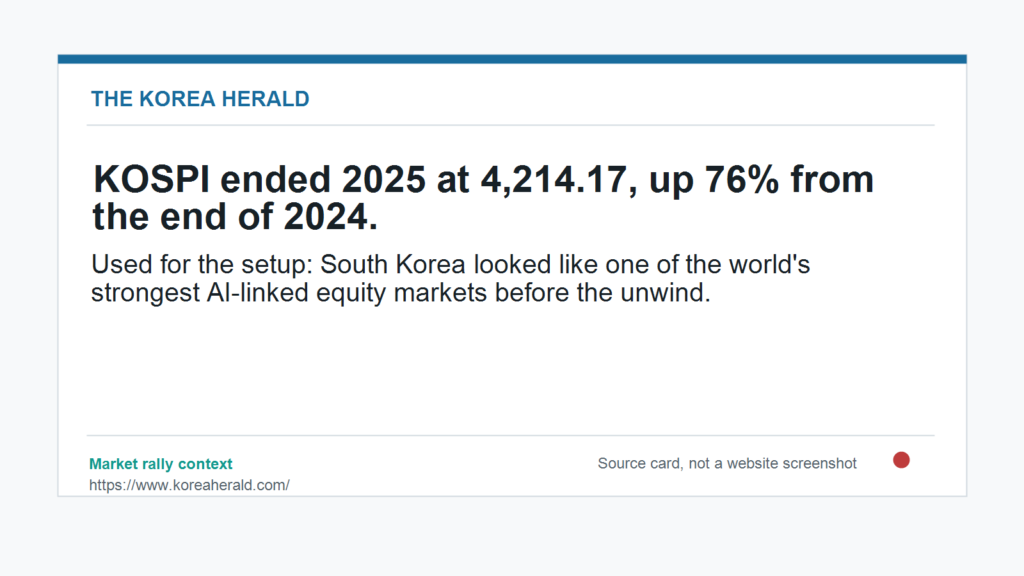
The Korea Herald reported that the Kospi ended 2025 at 4,214.17, up 76% from the end of 2024, its best year-end close in 43 years. By June 2026, the index had crossed 9,000 points for the first time, helped by enthusiasm around AI chips and SK Hynix’s next-generation memory roadmap.
This was not a random meme-stock moment.
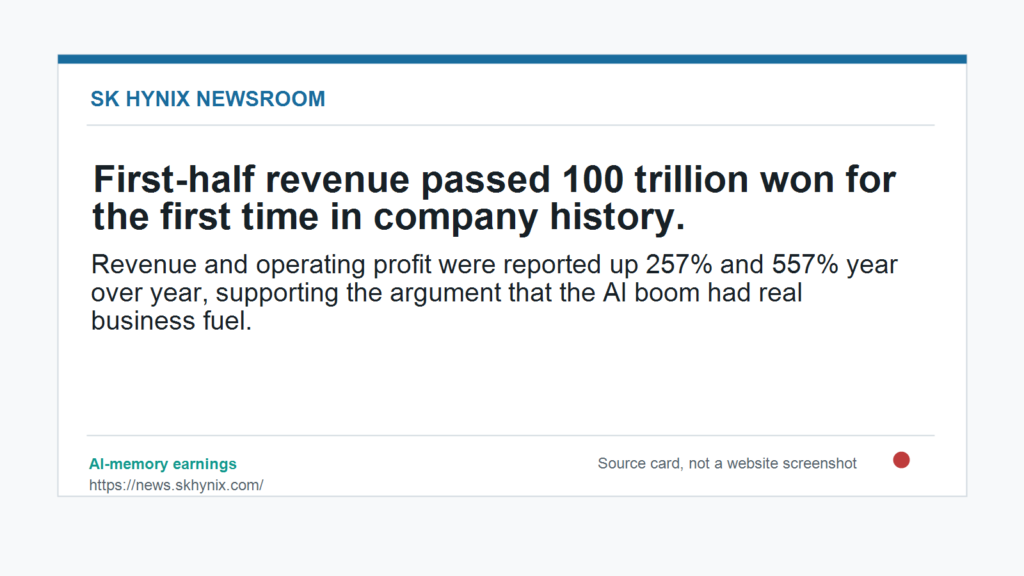
SK Hynix said its first-half revenue passed 100 trillion won for the first time in company history. The company reported that revenue and operating profit rose 257% and 557%, respectively, from a year earlier. Business Insider and The Wall Street Journal reported similar figures, including an operating margin around 76%.
That kind of number changes the way people think.
When a company is growing that fast, caution starts to look old-fashioned. The investor who says “maybe the price already reflects too much good news” sounds timid. The investor who buys more looks like the one who understands the future.
At least until the future gets repriced.
The Whole Market Was Leaning On Two Names
Here is where the South Korea story gets less comfortable.
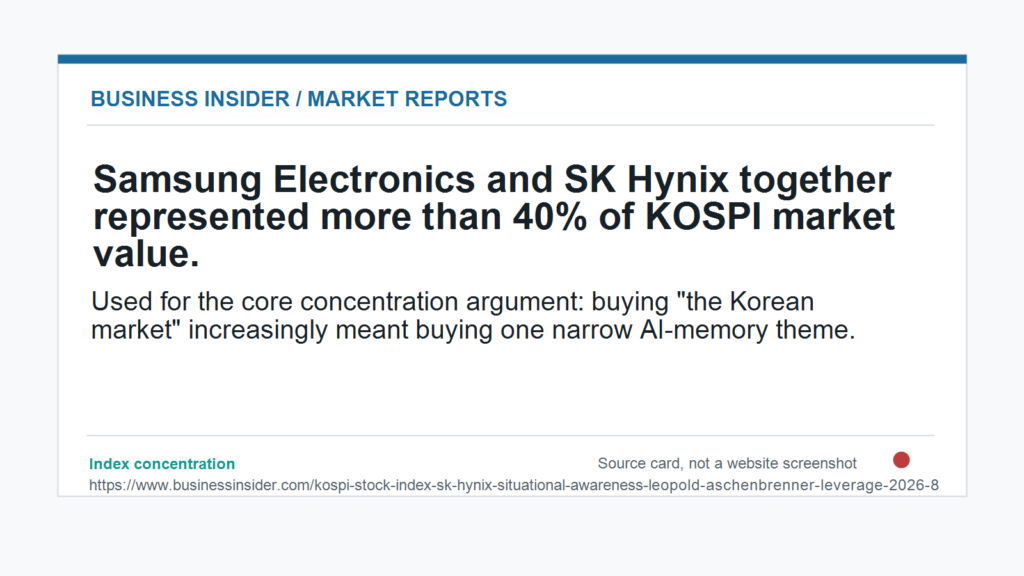
Buying the Kospi did not always mean buying a broad, balanced piece of South Korea’s economy. Several reports point to the same basic problem: Samsung Electronics and SK Hynix had become so large that together they represented more than 40% of the index’s market value.
That changes the nature of diversification.
A person could believe they were buying “the Korean market” when, in practice, they were taking a concentrated bet on two AI-linked chip companies. The label on the investment looked broad. The risk underneath was much narrower.
That does not make the thesis wrong. Samsung and SK Hynix were not empty stories. They were real businesses tied to real demand.
But concentration has a strange effect on investors. It hides in plain sight. A portfolio can contain many positions and still depend on one idea. An index can contain hundreds of companies and still move like a bet on a single theme.
In South Korea, that theme was AI memory.
And for a while, it worked beautifully.
Ordinary Investors Saw The Door Closing Somewhere Else
The retail boom mattered because it was not only about charts.
South Korean retail investors are often called gaemi, a Korean term commonly translated as “ants.” One small investor may not move a market. Millions moving together can.
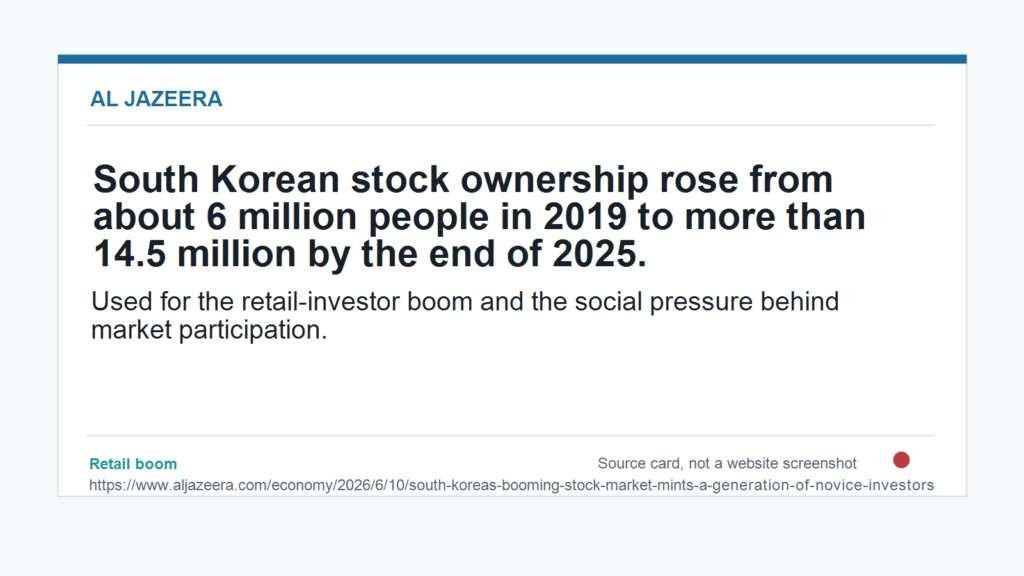
Al Jazeera, citing the Korea Securities Depository, reported that the number of South Koreans who own stocks rose from about 6 million in 2019 to more than 14.5 million by the end of 2025. That is not a small shift. It means stock ownership more than doubled in a few years.
Part of the pressure came from housing.
Some housing analyses put the average price of a Seoul apartment at roughly 14 years of salary for a young graduate. That figure depends on the exact methodology, so it should be used carefully. But the broader point is easy to understand: when housing feels unreachable, the stock market starts to look less like an option and more like the only door still open.
That is when investing changes emotionally.
It is no longer just “I want a better return.”
It becomes “I cannot afford to miss this.”
And that is a much more dangerous sentence.
Then The Shortcut Became The Trade
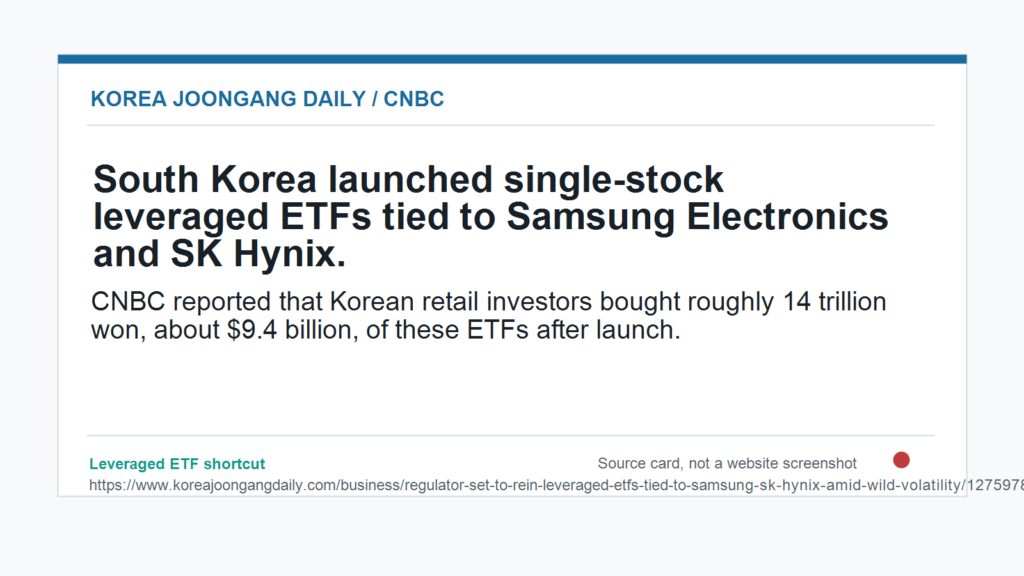
In May 2026, South Korea launched single-stock leveraged ETFs tied to Samsung Electronics and SK Hynix. Korea JoongAng Daily and The Korea Herald both reported on the products, along with the regulatory concerns that followed.
The pitch was easy to understand. Instead of buying a stock directly, investors could buy a fund designed to multiply that stock’s daily move. If the stock went up, the fund aimed to go up more. If the stock went down, the fund went down more.
The problem is hidden in the word “daily.”
Leveraged ETFs are not simple long-term amplifiers. They rebalance. They reset. They can perform very differently from what casual investors expect, especially when prices swing violently.
CNBC reported that after the May 27 launch, Korean retail investors bought a net 14 trillion won, about $9.4 billion, of these ETFs. That is an enormous amount of money to pour into a narrow leveraged trade in just weeks.
Think about what that means.
Investors were not only buying two companies that already dominated the index. They were buying leveraged exposure to those two companies after a huge run-up, inside a market where millions of new retail investors were already chasing the same story.
The trade was crowded before the leverage arrived.
The leverage made it combustible.
The Moment Investors Stopped Choosing
A normal selloff is painful. A forced selloff is different, because the investor is no longer fully in charge of the decision.
When investors buy with borrowed money, a falling position can trigger a demand for more collateral. If they cannot provide it, the broker can liquidate the position automatically.
That is a margin call.
Investing.com, citing Ioannis Blekos of Goldman Sachs’ trading desk, reported that more than 1.2 million leveraged retail accounts in South Korea triggered margin calls by July 13. The same report said roughly 320,000 to 360,000 accounts were fully liquidated by brokers.
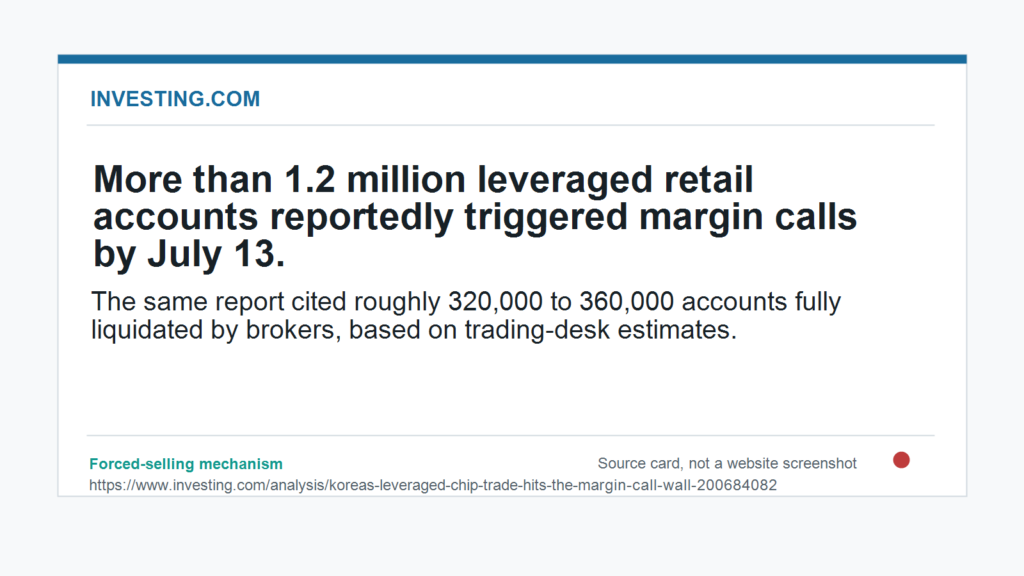
Those numbers should be treated as reported estimates, not clean official counts. One person can have more than one account, and trading-desk estimates are not the same as a public regulatory database.
But even with that caveat, the scale matters.
This was not simply investors changing their minds. It was a machine taking over the decision. Prices fell, leveraged funds had to rebalance, brokers demanded collateral, accounts were liquidated, and that selling pushed prices lower again.
The trade did not need everyone to panic at once.
It only needed enough forced selling to make panic rational.
The Crash Did Not Need The AI Story To Die
By late July, the damage was visible.
The Korea Herald reported that the Kospi fell below 5,300 on July 29 as selling intensified. Other outlets described trading halts on consecutive days, a rare sign of how violent the move had become. Business Insider reported that the Kospi ended July down 22% and had fallen about one-third from its June peak.
The exact percentage depends on the starting point.
The message does not.
A market that had been one of the world’s best performers suddenly became a case study in how quickly a crowded trade can reverse.
And the strange part is that the AI story did not have to collapse for this to happen. Demand for memory chips did not disappear overnight. SK Hynix did not suddenly become a weak company. Samsung did not stop mattering to global technology.
The market only needed expectations to become too high and ownership to become too fragile.
That is enough.
One China Headline Was Enough To Shake The Perfect Story
One of the shocks came from China.
Several reports said China had begun producing domestically developed DUV lithography machines, with early units expected for companies such as SMIC, Hua Hong, and CXMT. South China Morning Post reported that ASML shares fell more than 8% intraday in the U.S. before closing down 5.8% after The Information reported that China had started producing domestic DUV lithography machines through a state-backed company in Shanghai.
That does not mean China suddenly caught up with ASML at the most advanced end of chipmaking. Analysts cited by SCMP were careful not to overstate the threat.
But crowded markets do not always need proof.
Sometimes they only need doubt.
If everyone owns the same story, and that story depends on perfect growth, even a small crack can make investors ask whether the price has gone too far. In a normal market, that question can lead to a correction. In a leveraged market, it can start a chain reaction.
South Korea was already leaning forward.
The headline gave it a shove.
Why This Should Feel Familiar To U.S. Investors
The United States is not South Korea, and that distinction matters. The U.S. market is larger, deeper, and more diversified. Its biggest companies are not just two chipmakers. They span cloud computing, software, advertising, semiconductors, e-commerce, and consumer devices.
So no, South Korea is not a perfect map of what must happen next in America.
But it does show a mechanism that American investors should recognize.
The first ingredient is concentration. Clariti, citing RBC Wealth Management, put the Magnificent 7 at 33.8% of the S&P 500 in June 2026 and said the top 10 stocks represented more than 40% of the index. A separate chart attributed to Bloomberg, S&P Global, Citadel Securities, and GMI put semiconductor weight in the S&P 500 at 19.7% as of June 2026.
The exact numbers may vary depending on methodology. The direction is clear enough: the U.S. market is also leaning heavily on a small group of large technology companies.
The second ingredient is leverage. FINRA margin statistics show U.S. margin debt around $1.5 trillion in June 2026. Jennifer Nash put the figure closer to $1.53 trillion and said it rose 7.9% from May and 51.5% from a year earlier.
The third ingredient is short-term speculation. Cboe reported that 0DTE options activity kept growing in 2026, and a chart attributed to Bloomberg and Citadel Securities showed zero-days-to-expiration options reaching about 30% of total U.S. options volume by June.
Put simply, the U.S. market does not need to look exactly like Korea to share some of the same pressure points: a concentrated story, more leverage, more short-term trading, and a lot of confidence that the trend will keep working.
That combination does not predict a crash.
It creates fragility.
The AI Boom Has To Keep Justifying The Bill
There is one more piece of the puzzle: spending.
CNBC reported that AI-related spending could reach $700 billion this year. Moody’s/Data Center Dynamics estimated that six major U.S. hyperscalers could increase capital expenditures to about $700 billion in 2026. Tom’s Hardware cited forecasts around $725 billion for Amazon, Google, Meta, and Microsoft.
That number is almost hard to process.
AI is no longer just a software story. It is a data center story, a chip story, a memory story, a power story, a cooling story, and a financing story. The money spent by Amazon, Microsoft, Google, Meta, Oracle, and others becomes revenue for suppliers. That revenue becomes earnings. Those earnings help justify stock prices. Those stock prices attract more investors.
The loop can work. For a while, it can look unstoppable.
But the larger the spending gets, the more the market starts asking a different question: when does the money come back?
If AI infrastructure spending keeps producing revenue, profit, and productivity, the boom has support. If investors start to doubt the return on that spending, the market has to reprice not just one stock but the entire chain of assumptions around it.
That is why South Korea matters.
It showed how quickly a real trend can become unstable when the price, the leverage, and the expectations all move too far in the same direction.
The Uncomfortable Dot-Com Comparison
The dot-com comparison is useful, but only if we use it carefully.
The internet was real. It changed the world. Many of the broad claims about its importance were correct.
And investors still lost huge amounts of money.
The Nasdaq Composite peaked at 5,048.62 on March 10, 2000, then fell more than 75% by October 2002. The lesson was not that the internet was fake. The lesson was that a real technology can still become a terrible investment at the wrong price, in the wrong structure, with the wrong expectations.
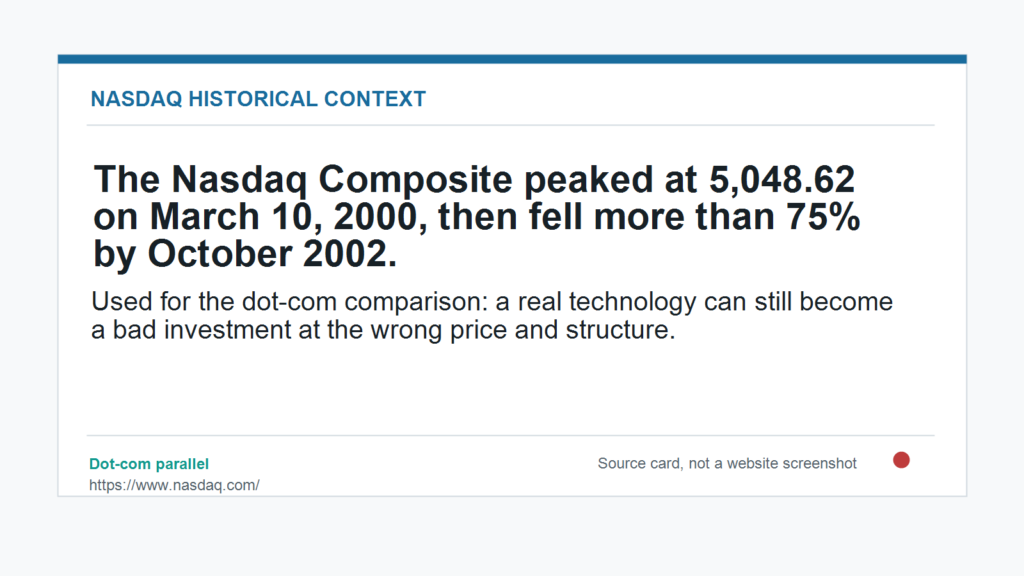
That is the uncomfortable parallel with AI.
AI may be real. The demand may be real. The infrastructure buildout may be real. The productivity gains may eventually be real.
None of that means every AI-linked investment is safe.
South Korea did not crash because investors imagined the entire chip cycle. It crashed because too many investors crowded into the same narrow, leveraged expression of that cycle.
That is a different kind of mistake.
And it is much easier to make.
The Hardest Part Is Watching Someone Else Get Rich First
This is where the story becomes personal.
The hardest part of a market like this is not understanding the chart. It is watching someone else make money faster than you.
That is what makes these booms so dangerous. In South Korea, the pressure was not only financial. It was social. The market was rising. AI stocks were exploding. Friends, relatives, neighbors, online traders, people who sounded less cautious and more confident, all seemed to be making money while the disciplined investor looked slow.
That is when discipline starts to feel like a mistake.
Maybe you should take more risk. Maybe you should concentrate the portfolio. Maybe you should use leverage just this once. Maybe the old rules do not apply to this new market.
And then the market turns.
The person who looked brilliant on the way up suddenly discovers that leverage does not care whether the long-term thesis was right. It only cares whether there is enough collateral in the account today.
That is the part worth bringing back to your own portfolio.
Not because Korea tells you exactly what will happen in the United States, Brazil, or anywhere else. It does not. But because the emotional trap is the same everywhere.
Every investor eventually lives through a moment when the reckless people look smarter.
Some people chase them. Some abandon the plan at the worst possible time. Some turn one strong theme into the whole portfolio because everyone else seems to be getting rewarded for doing it.
The boring investor has a harder job. Keep the allocation clear. Rebalance when one theme gets too large. Avoid leverage that can force a sale. Accept that sometimes the portfolio built to survive will look unimpressive next to the portfolio built to impress.
That does not feel heroic during a boom.
It feels lonely.
But that may be the whole point. The investor who survives long enough to buy when everyone is selling and trim when everyone is euphoric is usually not the one who predicted every crash. It is the one who did not build a portfolio that needed perfect timing to stay alive.
South Korea’s crash is not telling you to panic.
It is asking a quieter question.
If the hottest trade in your portfolio suddenly turned against you, would you still be able to wait?
Because the market does not have to break the global economy for leverage to break an investor.
Sometimes all it takes is one crowded trade, one reversal, and no time left to be right.
That same pressure can show up in smaller places too. Before taking bigger risks to “catch up,” it is worth checking whether money is already leaking quietly from your budget. HFD has a practical guide on how to find forgotten subscriptions before those small recurring charges become part of the background noise.
Sources Used
- Business Insider on KOSPI, SK Hynix, Samsung and leverage
- Business Insider on SK Hynix earnings and the KOSPI rout
- Korea JoongAng Daily on leveraged ETFs tied to Samsung and SK Hynix
- FINRA margin statistics
- Cboe Q2 2026 options market report
- Data Center Dynamics / Moody’s on hyperscaler capex
- Nasdaq on SK Hynix’s U.S. listing
