
Entertainment
Everything You Need to Know Before Watching Dune: Part Three
Dune: Part Three is not just another sequel. Here is what to know about Paul, Chani, Dune Messiah, and the books worth reading before the movie.
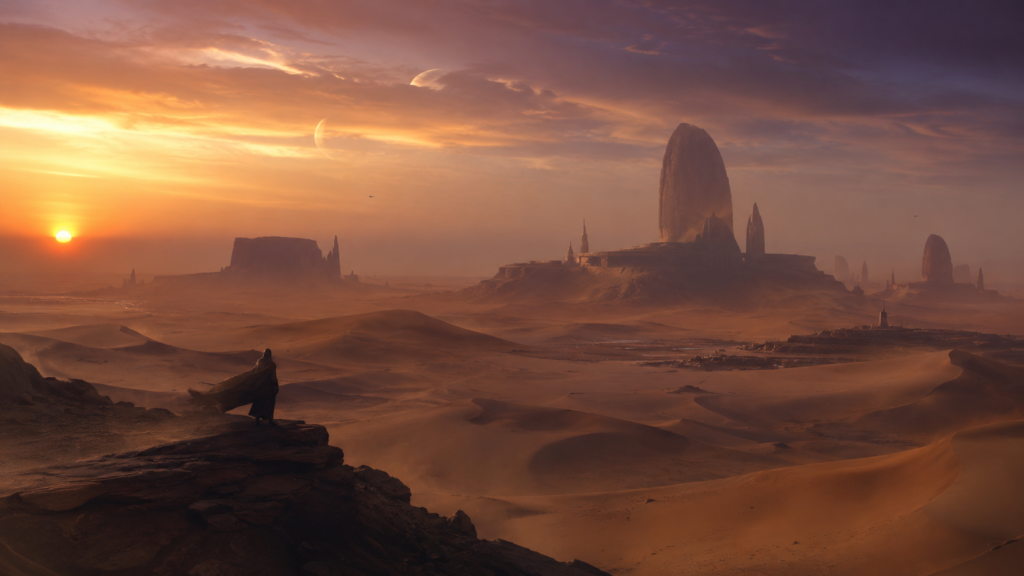
A solitary figure looks across an alien desert landscape, echoing the scale, mystery, and political weight behind Dune: Part Three. Original AI-generated image for Home Fit Digital.
Dune has always had a strange trick built into it.
You can understand the plot and still not fully understand what happened.
On the surface, the first two Denis Villeneuve films tell a massive rise-to-power story. Paul Atreides loses his house, survives in the desert, joins the Fremen, becomes Muad’Dib, defeats his enemies, and claims the imperial throne.
That sounds like a hero’s journey.
The problem is that Dune doesn’t really trust hero’s journeys.
Villeneuve’s first two films made Paul’s rise feel enormous: armies, sandworms, visions, knife fights, political marriage, religious war, and a spice economy that holds interstellar civilization together. Normal family drama, if your family has access to nuclear weapons and the most valuable planet in the known universe.
But Dune: Part Three is where the story turns around and studies the victory.
Not the spectacle of it.
The cost of it.
The film has been positioned as the concluding chapter of Villeneuve’s trilogy, with the story moving beyond Paul’s seizure of power and into the consequences of his rule. That matters because this isn’t just a continuation of the adrenaline from Dune: Part Two. It’s a different kind of story. The question is no longer whether Paul can survive long enough to take the throne.
The question is what the throne does to him, to the people around him, and to the civilization that now has to live inside his legend.
Before watching, you don’t need to memorize every faction, bloodline, or Bene Gesserit sideways glance. You need the core map: what Paul became, why Chani matters, why Dune Messiah is the book to know, and why this chapter probably won’t treat “chosen one” as a compliment.
The Hero Problem
Paul Atreides doesn’t begin as the villain of his own story.
That’s what makes the whole thing uncomfortable.
He starts as the son of Duke Leto Atreides and Lady Jessica, a young noble whose family is sent to Arrakis and then betrayed. House Atreides is nearly destroyed. Paul escapes into the desert with his mother, joins the Fremen, learns their ways, and becomes Muad’Dib.
So far, that looks clean enough.
Then power enters the story.
By the end of Dune: Part Two, Paul has defeated Feyd-Rautha, forced Emperor Shaddam IV out of power, accepted a political marriage to Princess Irulan, and pushed the Fremen toward a wider war against the Great Houses.
That’s a win if you’re reading the scoreboard.
It’s a disaster if you’re reading the room.
Paul is no longer just a gifted survivor. He’s emperor, prophet, military leader, religious symbol, and the person standing over the most important resource in the universe. Spice comes from Arrakis. Spice makes interstellar travel and imperial power possible. Whoever controls Arrakis controls the system that everyone else depends on.
In plain English, Paul doesn’t just win a war. He takes control of the supply chain that keeps civilization moving.
Thousands of years in the future, humanity still can’t escape logistics. Very inspiring. Deeply annoying.
Dune Messiah Is the Key
If you want to read one book before Dune: Part Three, make it Dune Messiah.
That doesn’t mean the movie will adapt it line by line. Villeneuve has already made meaningful changes in the first two films, especially around Chani. But Dune Messiah is the essential bridge because it asks the question most hero stories avoid.
What happens after the chosen one wins?
The first Dune novel gives you the rise.
Dune Messiah gives you the bill.
It’s shorter, colder, and more political than the first book. There is less “young man becomes desert legend” energy and more “a galactic regime begins eating its own architecture.” That shift isn’t a weakness. It’s the point.
Frank Herbert wasn’t building a clean fantasy about a perfect savior. He was warning readers about charismatic leaders, religious politics, and the danger of giving history a single human face.
Paul can see possible futures. At first, that sounds like the ultimate advantage. But Dune treats it more like a trap. If every path leads to damage, seeing the paths doesn’t make Paul free.
It just gives him a better view of the disaster.
Not exactly a beach read. Though technically, there is a lot of sand.
Chani Is the Break Point
Chani walking away at the end of Dune: Part Two may be one of Villeneuve’s most important choices.
In Frank Herbert’s original story, Chani remains deeply tied to Paul’s domestic and political future. In the films, she becomes something sharper: the person who sees the machinery forming around him and refuses to cheer just because everyone else has decided the music is sacred.
That makes her crucial for Part Three.
Chani isn’t there simply to ask whether Paul still loves her. That would shrink the story into palace romance, and Dune already has enough expensive architecture. Her real function is moral pressure.
She forces the audience to sit with the question Paul’s followers don’t want to ask: are his choices strategy, betrayal, necessity, or all three at once?
Current public descriptions of Dune: Part Three point toward a story about the consequences of Paul’s rule, with Chani, Irulan, Alia, Duncan, and the conspiracy around the emperor becoming more important. If that holds, Villeneuve isn’t softening the problem at the center of the story.
Good.
Dune needs someone who isn’t hypnotized by the legend of Muad’Dib.
Paul may be emperor. Chani is the person who remembers he was once just Paul.
Irulan Is Not Background Decoration
Princess Irulan could look like a political accessory if you only watch casually.
She isn’t.
Irulan is the daughter of the old emperor and Paul’s political wife. That makes her a bridge between the regime Paul overthrew and the regime he now rules. It also places her inside one of the most uncomfortable marriages possible: one designed for legitimacy, not love.
In Dune, marriage is rarely just marriage.
It’s paperwork with consequences.
Irulan gives Paul’s rule a formal shape. Chani represents the emotional wound underneath it. That triangle isn’t interesting because of jealousy. It’s interesting because each woman reveals a different part of Paul’s power.
Chani shows what Paul lost.
Irulan shows what Paul accepted.
Neither is decorative. Both are structural.
Duncan Comes Back Wrong
Jason Momoa’s return as Duncan Idaho isn’t just the franchise doing a victory lap because audiences liked him.
Duncan died in the first film. In Dune, that doesn’t always end the paperwork.
In the source material, Duncan returns as a ghola, a regenerated human made from the cells of a dead person. Simple version: it’s resurrection with terms and conditions.
That matters because Duncan belongs to Paul’s old life. He was loyal to House Atreides before Paul became Muad’Dib, before the throne, before the religious war, before every personal relationship got pulled into imperial machinery.
Bringing Duncan back puts Paul’s past inside his present.
And in a story where memory, identity, and loyalty are never simple, that isn’t comforting. It’s dangerous.
Most franchises bring back a beloved character so the audience can cheer. Dune brings him back so everyone has to ask who paid for the resurrection and what they expect in return.
Much healthier. Very normal.
Alia Changes the Atreides Problem
Alia Atreides, Paul’s sister, is not just another royal family member.
She is one of the strangest consequences of the Bene Gesserit world: bloodlines, ancestral memory, religious engineering, and political ambition compressed into one person. The films have already teased her in an unusual way, and Anya Taylor-Joy’s involvement points to a larger role in Part Three.
Alia matters because Dune is never only about Paul.
It’s about systems that outlive individuals.
The Bene Gesserit spent generations manipulating bloodlines. The Fremen religion was shaped by planted myths. The Imperium was built on extraction. Arrakis was treated as a resource before it was treated as a home.
Paul is the explosion.
Alia is part of the fallout.
The Atreides family doesn’t get a quiet second generation. Of course it doesn’t. That would require Dune to believe in peace, tidy inheritance, and emotionally stable dynasties.
It does not.
The Time Jump Does Work
A major time jump isn’t just a way to age up the characters.
It changes what kind of movie Dune: Part Three can be.
A direct sequel would still be running on the heat of Paul’s takeover. A story set years later can ask what his rule actually did. The war has had time to spread. The empire has had time to adjust. Enemies have had time to stop panicking and start planning.
That’s where Dune becomes more interesting than a simple rebellion story.
Rebellion stories are clean. Empire stories are messy.
Once Paul sits on the throne, every decision carries the weight of government, religion, military force, economics, and prophecy. He can’t simply be brave anymore. Brave is easy compared with ruling a system that wants to turn every choice into doctrine.
The first two movies were about reaching the throne.
Part Three is about what the throne takes from the person sitting on it.
What to Remember Before Watching

You don’t need a lore degree. You need a clean mental map.
Paul is the son of Duke Leto Atreides and Lady Jessica. House Atreides was betrayed after taking control of Arrakis. The Harkonnens were their brutal rivals and former rulers of the planet. The Fremen are the desert people of Arrakis, shaped by survival, faith, and the dream of transforming their world.
Spice is the substance that makes interstellar civilization function. The Bene Gesserit are a powerful sisterhood that manipulates politics, bloodlines, religion, and perception across generations. Their planted myths help prepare the ground for Paul’s rise among the Fremen.
That last part is important.
Paul doesn’t become a messiah in an empty room. He steps into a story other people prepared before he was born.
That’s why Dune is sharper than a normal chosen-one saga. It doesn’t only ask whether Paul is special.
It asks who benefits when people believe he is.
What to Read Before Dune: Part Three
If you want to read before the movie, keep it practical. You do not need to buy half a shelf just to understand one film. Start with the books that actually help.
| Book | Best for | Link |
|---|---|---|
| Dune by Frank Herbert | Readers who only watched the movies and want the full foundation. This edition is a cleaner pick than a random mass-market copy if you want something that feels more shelf-worthy. | Check price at Amazon |
| Dune Messiah by Frank Herbert | The most important pick for Dune: Part Three. This is the book most directly tied to Paul’s rule, Chani, Irulan, and the consequences of becoming Muad’Dib. | Check price at Amazon |
| Children of Dune by Frank Herbert | Readers who want to understand where the Atreides legacy goes after Paul. This is where the next generation becomes impossible to ignore. | Check price at Amazon |
| Frank Herbert’s Dune Saga 3-Book Boxed Set | The cleanest path for most new readers: Dune, Dune Messiah, and Children of Dune in one set, without committing to the entire original saga. | Check price at Amazon |
| Frank Herbert’s Dune Saga 6-Book Boxed Set | The full Frank Herbert run. Best for readers who already know they want the long, strange version of the saga. Not casual. Very Dune. | Check price at Amazon |
Affiliate disclosure: As an Amazon Associate, HFD earns from qualifying purchases.
The simplest recommendation is the 3-book boxed set. It covers the foundation, the direct Part Three source material, and the next step in the Atreides mess without asking you to turn your nightstand into a small religious archive.
If you only want one book, choose Dune Messiah. It is the most direct bridge into the new movie.
The Real Warning
The easy version of Dune is this: Paul becomes powerful.
The better version is this: Paul becomes trapped inside the power people gave him, the power he took, and the future he can see but can’t neatly escape.
That’s why Dune: Part Three shouldn’t feel like a simple finale. It should feel like the point where the story turns around and judges its own hero.
Paul’s rise was thrilling because Villeneuve made it feel massive, dangerous, and almost inevitable. The sandworms helped. They usually do.
But Herbert’s larger warning was never “follow the impressive man into the desert.” It was closer to the opposite: be careful when history, religion, politics, and desperation all point at one person and call him destiny.
That’s the Dune trap.
The first two films made you feel the pull of Paul Atreides. Part Three has to show what that pull costs.
For a broader path through the franchise, our Dune books and movies guide before Part Three covers the bigger order.
Sources
- Creative Media Authority Abu Dhabi / ADFC: Dune: Part Three trailer and release details
- Creative Media Authority Abu Dhabi: first-look teaser and production details
- BBFC: Dune: Part Three trailer classifications and listed cast
- Penguin Random House: Frank Herbert’s Dune Saga 6-Book Boxed Set
- Penguin Random House Retail: Frank Herbert’s Dune Saga 3-Book Boxed Set
