
Vehicles
Why American Semi-Trucks Have Long Noses
American semi-trucks have long noses for reasons that go beyond style. U.S. road rules, long-haul comfort, easier engine access, and the space of American highways all helped the conventional cab survive while Europe kept the cab-over design.
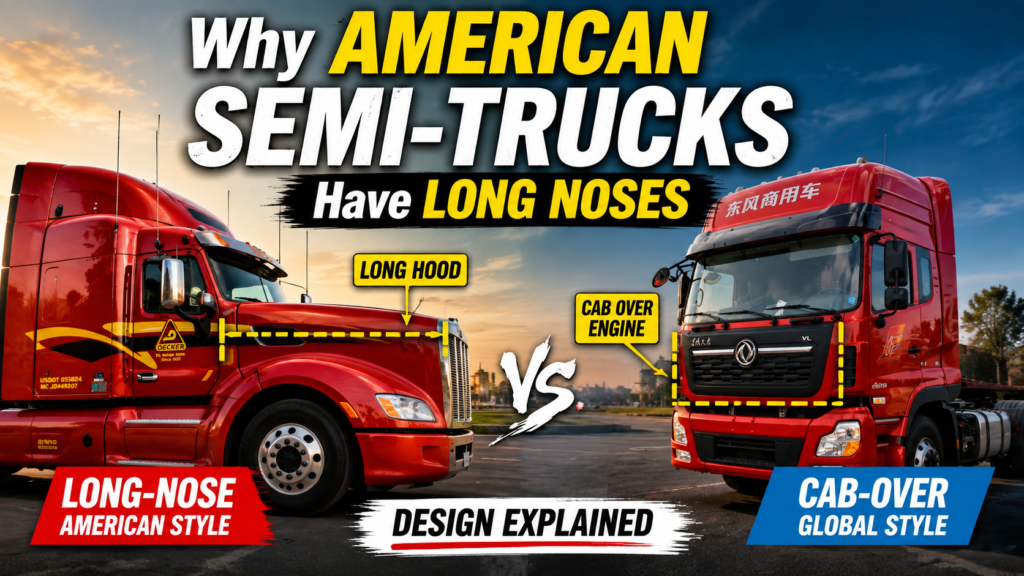
So why do American semi-trucks have long noses? The short answer is that the United States made room for them: on the road, in the regulations, and in the way long-haul trucking became a job people had to live inside.
I used to think the answer was mostly cultural.
American semi-trucks have long noses because, well, look at them. They seem designed by a country that looked at a normal truck and said, “Good, but what if it had more forehead?”
Then you put one next to a European truck and the contrast becomes almost rude.
The American tractor stretches forward with a long hood, a big grille, and the general attitude of something that expects the highway to move out of its way. The European truck is blunt and upright, with the cab pushed forward over the engine, as if someone measured the street, frowned, and said, “No. We are not wasting 8 feet on vibes.”
The easy explanation is that Americans like big things and Europeans like practical things. That explanation is satisfying. It is also too lazy.
So I went looking for the less convenient version, because truck design almost never survives for one reason. Especially not for decades. Especially not when fuel, freight, drivers, mechanics, regulators, roads, and accountants are all standing around the same machine with opinions.
The long nose exists because America made room for it. Not emotionally. Literally.
The Simple Version Is About Length
A semi-truck is a packing problem before it becomes a cultural symbol.
You need an engine. You need cooling. You need axles, suspension, steering gear, fuel tanks, emissions equipment, batteries, air systems, a cab, and often a sleeper. Behind all of that, you need the trailer, because the trailer is the part that usually makes the money.
There are two obvious ways to arrange the front.
A cab-over puts the cab above the engine. The driver sits high and far forward. The truck gets a short, flat face. This saves length, improves placement in tight areas, and makes a lot of sense when roads, cities, and regulations punish wasted space.
A conventional truck puts the engine in front of the cab, under a hood. The driver sits behind the engine. The truck gets longer, but the engine becomes easier to reach, the cab can be quieter, and the whole machine can be stretched into something more comfortable for long-distance work.
That is the boring mechanical explanation. The interesting part is why the United States and Europe made different compromises.
America Used To Need Cab-Overs Too
This is the part that keeps the story from becoming a simple “American excess” joke, though I admit the joke is sitting right there wearing chrome.
American cab-over trucks were once completely serious long-haul machines. They were not some strange European phase. They made sense because older length rules made tractor length painfully important.
If the law limits the total length of the tractor and trailer together, then every inch used by the tractor is an inch not available for cargo. That is not philosophy. That is money.
Freightliner’s own history shows this clearly. In the early 1950s, the company sold cab-over sleepers for transcontinental work, and it described one overhead sleeper model as built for long-haul use while meeting restrictive length laws. That sentence does a lot of work.
The cab-over was not just a design choice. It was a way to keep the cab from stealing space from the trailer. Put the driver over the engine, shorten the tractor, and protect the cargo length. Simple. Brutal. Effective.
Then the rules changed. The Federal Highway Administration says that, on the National Network and reasonable access routes, states may not impose an overall vehicle length limit on most truck tractor-semitrailer combinations. The federal framework protects minimum trailer lengths, such as 48 feet for many semitrailers, rather than forcing the tractor and trailer into one single total-length box in those cases.
That is the hinge: once the tractor is not punished in the same way for being long, the conventional layout becomes much easier to justify. The engine can move forward. The cab can move back. The sleeper can grow. The truck can become a long-distance workplace instead of a geometry problem with headlights.
This is where I think the useful point begins: American trucks did not get long noses because short trucks stopped working. They got long noses because, on many major freight routes, the rules stopped making short tractors necessary.
A Small Way To See The Difference
If you want the shape difference to become obvious without standing in a truck stop parking lot, scale models help.
A long-nose Kenworth W900 model makes the American conventional layout easy to see: engine out front, cab behind it, and plenty of hood before the driver even enters the picture. A White Freightliner cabover model shows the opposite idea, with the cab pushed forward to save length. The Peterbilt 579 sits in a more modern aerodynamic middle ground, while Scania models are useful for seeing how cab-over proportions became so normal outside the United States.
Affiliate disclosure: Some of the links below are affiliate links. If you buy through them, I may earn a small commission at no extra cost to you.
- Kenworth W900 diecast model
- White Freightliner cabover model kit
- Peterbilt 579 Diecast Masters 71091
- Scania diecast truck model
The Hood Is Not Just Decoration
Now, yes, some long-nose American trucks are clearly enjoying themselves.
There is no purely practical explanation for every polished tank, tall stack, paint stripe, and grille large enough to make a building feel underdressed. At some point, function leaves the meeting and pride takes the chair.
A big diesel engine is not a polite little appliance, and the hood itself has a real job. The engine is hot, heavy, expensive, and surrounded by systems that need inspection: belts, hoses, filters, cooling components, turbochargers, pumps, wiring, emissions equipment. All the charming little pieces that can turn a freight schedule into a roadside meditation session.
On a conventional truck, you open the hood and the engine is right there. Not always easy, but reachable.
That matters because trucks live or die by uptime. A truck sitting in a shop is not earning. A truck waiting on a simple inspection or repair is not romantic. It is just expensive.
A cab-over can absolutely be serviced, and many are cleverly designed. But the basic tradeoff remains: when the engine is under the cab, the cab becomes part of the access problem. When the engine sits under a hood, the hood becomes a very large door.
I like that explanation because it is less glamorous than the truck itself. The long hood looks dramatic, but its most useful argument may be maintenance. That is beautifully unsexy, which is how you know it probably matters.
The Driver Is Part Of The Design
There is another thing I think people miss when they talk about American trucks from the outside.
A long-haul tractor is not just a vehicle. For many drivers, it is an office, bedroom, dining room, storage unit, weather shelter, and unpaid therapist with an air horn. So the cab matters.
The conventional layout puts the driver behind the engine instead of directly above it. Modern cab-overs can be comfortable, but distance still helps: less heat, less noise, less vibration, more room to build a larger sleeper, and more flexibility for storage and living space.
That becomes important in the United States because the distances can be absurd.
A “long drive” in some countries means you crossed a border, passed three languages, and had a snack. In America, it can mean you are still in Texas and your podcast has developed a sequel.
Long routes reward comfort, space, and trucks that feel less like a temporary seat and more like a place a human being can survive for days.
This is where culture and practicality start blending together.
The long hood became part of the American truck identity because it was useful enough to survive and visible enough to become emotional. Owner-operators, especially, often care about the truck as a personal statement. The machine has to work, but it also says something.
A European fleet tractor often looks like it was designed by people who respect spreadsheets and urban planning. An American long-nose tractor sometimes looks like it was designed by someone who respects torque, sunsets, and the constitutional right to be seen from orbit.
Both are valid. One is just louder about it.
Europe Did Not Forget The Hood
Now move the same problem to Europe, where the roads are different. The cities are older and tighter. There are more dense urban routes, ferry terminals, loading zones, roundabouts, and awkward delivery spaces where a long hood starts to look less like freedom and more like a parking ticket waiting to happen.
The regulations are different too. The European Union’s weights and dimensions framework sets common limits for heavy-duty vehicles. A common maximum length for an articulated vehicle is 16.5 meters, and Great Britain’s public guidance lists the same figure for articulated HGVs.
In that environment, a long hood becomes expensive because it takes up length without carrying cargo.
So the cab-over layout makes sense: push the cab forward, put the engine underneath, keep the tractor compact, and preserve as much useful length as possible for the trailer and the job.
That is not because European engineers looked at a Peterbilt and failed to understand the appeal. They understood it perfectly well. Then they looked at their streets and regulations and probably laughed in metric.
The cab-over is not a lack of imagination. It is what happens when the machine has to fit.
The Visibility Argument Matters Too
There is also a human safety side to this.
When you drive in dense urban traffic, the area immediately around the truck becomes critical. Pedestrians, cyclists, parked cars, curbs, tight corners, delivery bays. A shorter front end and higher forward position can help the driver place the vehicle more precisely.
Scania describes its P-series trucks around urban and regional work, with emphasis on visibility, driveability, low cab height, and easy access. That is not marketing fluff floating in space. It is a response to the environment where the truck works.
If your daily job involves tight streets and vulnerable road users, the ability to see and maneuver may matter more than having a hood long enough to host a small barbecue. Again, different problem. Different answer.
But America Still Uses Short Trucks
This is where I would be careful not to turn the article into a cartoon, because American trucks do not all have long noses.
You see cab-over and low-cab-forward designs in refuse work, urban delivery, ports, fire trucks, construction, and other vocational jobs where compactness matters. If the route is tight enough, the long hood stops looking heroic and starts looking like extra homework.
Even within American trucking, the job chooses the shape. A regional delivery truck does not need to cosplay as a cross-country road warrior, a refuse truck does not need a stretched hood to creep through neighborhoods, and a port truck needs maneuverability and visibility more than highway swagger.
So the real divide is not America versus Europe. It is space versus constraint. When space is expensive, the cab-over is elegant; when space is available, the conventional truck starts making a stronger case.
The Long Nose Survived Because It Solves More Than One Problem
This is the part I would keep after stripping away the stereotypes: the long-nose American semi survived because it solved several problems at once. It gave the engine space, made many service tasks more accessible, gave the cab more separation from the powertrain, and allowed larger sleepers for long-haul work.
It also fit a road network where long interstate runs are normal, and it matched a regulatory environment where many tractor-semitrailer combinations were not squeezed by one overall length cap on major freight routes. That combination matters. A design can be beautiful, dramatic, or deeply satisfying to look at, but if it keeps getting in the way of the job, the job eventually wins.
In this case, the long hood did not keep getting in the way. It kept making sense often enough to stay. And then, because humans are humans, it became a symbol.
That last part matters. Machines do not stay purely practical for long. Give people enough time with a tool and they start attaching identity to it. Trucks get names. Paint gets chosen. Chrome gets polished. A hood becomes a face.
Europe built trucks that say: space is limited, use it carefully. America built trucks that say: I checked the map, and apparently we have room. I don’t think one answer is automatically better. I think each one reveals the world around it.
The European cab-over tells you about dense roads, strict dimensions, and the value of compactness. The American long-nose truck tells you about distance, maintenance, driver comfort, and a freight culture that had enough room to turn practicality into presence. That is why the hood is there. Not just because Americans like big things, though, to be fair, we have not exactly disproven that part.
Related read: The same kind of tradeoff shows up with regular cars too. A vehicle can look cheap upfront and still become expensive once maintenance, parts, fuel, and repairs enter the conversation. I broke that down here: Why Cheap Used Cars Can Become Expensive Ownership Mistakes.
Sources
- FHWA – Federal Size Regulations for Commercial Motor Vehicles
- FHWA – Commercial Vehicle Size and Weight Program
- European Commission – Weights and Dimensions
- Freightliner – A Tradition of Innovation
- Kenworth W900L
- Peterbilt 579
- Scania P-series
